<?xml version="1.0" encoding="utf-8" ?>
<rdf:RDF xmlns:rdf="http://www.w3.org/1999/02/22-rdf-syntax-ns#" xmlns:dc="http://purl.org/dc/elements/1.1/" xmlns:syn="http://purl.org/rss/1.0/modules/syndication/" xmlns="http://purl.org/rss/1.0/">


<channel rdf:about="https://kahea.org/search_rss">
  <title>KAHEA</title>
  <link>https://kahea.org</link>

  <description>
    
            These are the search results for the query, showing results 1 to 9.
        
  </description>


  <image rdf:resource="https://kahea.org/logo.png"/>

  <items>
    <rdf:Seq>
      
        <rdf:li rdf:resource="https://kahea.org/press-room/press-clips/not-on-our-land"/>
      
      
        <rdf:li rdf:resource="https://kahea.org/blog/laughable-public-process-changes-to-conservation-protections"/>
      
      
        <rdf:li rdf:resource="https://kahea.org/blog/collaborate-much"/>
      
      
        <rdf:li rdf:resource="https://kahea.org/blog/exemptions-gone-wild"/>
      
      
        <rdf:li rdf:resource="https://kahea.org/blog/manufacturing-consent"/>
      
      
        <rdf:li rdf:resource="https://kahea.org/blog/action-alert-haleakala-solar-telescope"/>
      
      
        <rdf:li rdf:resource="https://kahea.org/blog/haleakalaahhhhh-wasssps"/>
      
      
        <rdf:li rdf:resource="https://kahea.org/blog/arguments-supporting-telescope-are-fallacies"/>
      
      
        <rdf:li rdf:resource="https://kahea.org/blog/action-alert-unite-to-save-the-scared-summits"/>
      
    </rdf:Seq>
  </items>

</channel>


  <item rdf:about="https://kahea.org/press-room/press-clips/not-on-our-land">
    <title>Not on our land</title>
    <link>https://kahea.org/press-room/press-clips/not-on-our-land</link>
    <description>The fate of the Thirty Meter Telescope on Mauna Kea could be linked to a looming, lesser-known fight at the Hawaii Supreme Court over a Haleakala telescope</description>
    <content:encoded xmlns:content="http://purl.org/rss/1.0/modules/content/"><![CDATA[<p>On the same day 31 protesters were arrested trying to stop construction of the giant Thirty Meter Telescope atop Mauna Kea, lawyers appeared at the Hawaii Supreme Court attempting to block another major mountaintop astronomy project.</p>
<p>The $300 million Daniel K. Ino­uye Solar Telescope, in the works on Maui for over a decade, is under construction in the Science City area of the summit of Hale­akala. When it is completed in 2019, the largest solar telescope in the world will give astronomers the best view of the sun they've ever had.</p>
<p>But not if Kila­kila o Hale­akala has its way. The small group of Native Hawaiians has been battling the project in the public-review proc­ess and the courts for years, although largely under the radar.</p>
<p>Now the case has reached the state's highest court, and the group is hoping for a ruling that will block construction.</p>
<p>With many similarities between the Hale­akala and Mauna Kea cases, the court is now weighing broad legal issues that not only could affect the Ino­uye telescope, but the future of the $1.4 billion TMT project.</p>
<p>"We're watching the Maui case very closely," said Kealoha Pisciotta, president of Mauna Kea Anaina Hou and one of the individuals suing to halt the TMT project.</p>
<p>Both projects were shepherded by the University of Hawaii on land subleased from the state Board of Land and Natural Resources. Both projects are being funded mostly from institutions and entities based away from Hawaii.</p>
<p>While the Thirty Meter Telescope is being billed as the largest optical telescope in the world, the 4-meter Ino­uye project will be the world's most powerful ground-based solar telescope, enabling solar astronomers to see more clearly into the heart of sunspots, flares and other solar phenomena that influence Earth.</p>
<p>The massive TMT is planned to rise 18 stories and be the tallest structure on Hawaii island when built, while the Maui telescope is expected to reach 14 stories.</p>
<p>In both cases a small group of Native Hawaiians has contested these projects every step of the way, arguing that the mountaintop is sacred and that these enormous developments will desecrate and overwhelm a place of spectacular beauty and significant traditional cultural resource.</p>
<p>While the Kilakila case has advanced to the Hawaii Supreme Court, the Mauna Kea case is gearing up for a hearing before the Hawaii Intermediate Court of Appeals. Both projects won a green light to begin construction even as appeals were filed in court.</p>
<p>One of the key legal issues being argued in both cases is whether the Board of Land and Natural Resources failed to meet all eight criteria required before construction is allowed in the state's protected Conservation District, which the court has already observed as tolerating the least degree of development.</p>
<p>David Kimo Frankel, the Native Hawaiian Legal Corp. staff attorney representing Kila­kila, said the group is not disputing the fact that astronomy facilities are listed as one of the legal uses of the conservation district. Rather, he said, this specific project — given its unprecedented size, industrial appearance and substantial impacts, among other things — is inconsistent with the purposes of conservation lands.</p>
<p>Frankel said the state Legislature's history of amendments to the Conservation District law shows increasingly restrictive requirements for development, and the BLNR should have analyzed whether this specific astronomy project is consistent with the purposes of the district.</p>
<p>During arguments at the Hawaii State Supreme Court on April 2 — the same day protesters were being arrested on Mauna Kea — many of the same issues that are integral to Mauna Kea were argued before the court, including whether developers can offer mitigating measures that do nothing to offset the physical impact of a project and whether the BLNR prejudged the issue.</p>
<p>A ruling could lead to greater restrictions over development in the Conservation District, an area that encompasses 2 million acres including the summits of Hale­­akala and Mauna Kea.</p>
<p>Ki‘ope Raymond, president of Kila­kila o Hale­akala and longtime University of Hawaii Maui College Hawaiian-studies professor, said it hurts when he goes to Maui's 10,000-foot mountaintop and sees the giant shell of the Ino­uye telescope. He said the structure is even more imposing than he thought it was going to be.</p>
<p>Kilakila, which formed after many Native Hawaiians on Maui expressed their disdain for the proposal, kept trying to find a compromise with the institutions driving the project, he said.</p>
<p>"But they didn't compromise on anything," he said, including refusing to budge on the size or even the color of the dome.</p>
<p>Attempts by the Hono­lulu Star-Advertiser to reach the leadership of the Ino­uye telescope project with telephone and email requests were unsuccessful last week.</p>
<p>Pisciotta, a veteran foe of Hawaii island astronomy projects, said there's a special connection between Hale­akala and Mauna Kea because they are spiritually aligned. Both are above the clouds, in the heavenly realm and sacred high-altitude points that are open gateways to heaven, she said.</p>
<p>Pisciotta said she's feeling good, even optimistic, about what might come out of the Kila­kila case because the Hawaii Supreme Court has a history of supporting environmental and cultural rights, such as the time when the court ruled in favor of public access in the PASH (Public Access Shoreline Hawaii) case in the 1990s.</p>
<p>Six months ago, like on Maui, only a small, hard-core group was fighting against the TMT, maneuvering through the lengthy public review and legal channels.</p>
<p>"If we weren't bringing these cases, the TMT would have been built already," she said.</p>
<p>Since then a handful of young activists blocked construction crews, set up camp and galvanized a mountain of support through social media.</p>
<p>"It's changing the face of activism," Pisciotta said. "It's the modern tool of activism."</p>
<p>Raymond said he is impressed with the enthusiasm of the young activists, and even Kila­kila o Hale­akala has seen a surge in interest.</p>
<p>"Many Native Hawaiians are focusing on the summits and asking, What is my responsibility to hold the mountain sacred?" he said.</p>]]></content:encoded>
    <dc:publisher>No publisher</dc:publisher>
    <dc:creator>Lauren Muneoka</dc:creator>
    <dc:rights></dc:rights>
    
      <dc:subject>sacred summit</dc:subject>
    
    
      <dc:subject>sacred summits</dc:subject>
    
    
      <dc:subject>Haleakala</dc:subject>
    
    <dc:date>2015-05-12T03:01:56Z</dc:date>
    <dc:type>Press Clip</dc:type>
  </item>


  <item rdf:about="https://kahea.org/blog/laughable-public-process-changes-to-conservation-protections">
    <title>Laughable public process: changes to conservation protections</title>
    <link>https://kahea.org/blog/laughable-public-process-changes-to-conservation-protections</link>
    <description></description>
    <content:encoded xmlns:content="http://purl.org/rss/1.0/modules/content/"><![CDATA[<script type="text/javascript" src="http://s0.wp.com/wp-content/plugins/adverts/adsense.js?m=1268666600g&1"></script><p><em> </em></p>
<p><em> </em></p>
<p><em> </em></p>
<div><span style="font-style:normal;"><em> </em>
<div><img src="/kahea/kahea/images/20100817-rhia5cpe1kk7ww35x61f7wrjph.jpg" title="OCCL Hearing Hawaii" height="240" width="584" alt="OCCL Hearing Honolulu" class="alignnone" /></div>
<div></div>
<div><em>From Marti:</em></div>
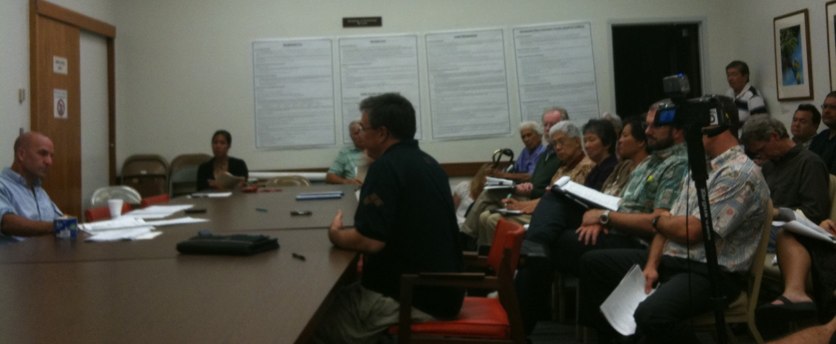
<div><span style="font-style:normal;">On Thursday night, the Office of Conservation and Coastal Lands (OCCL) held a public hearing in Honolulu on their proposed changes to the regulations protecting conservation districts. The first major changes in 15 years&#8230; so it wasn&#8217;t surprising to see the meeting was standing room only.Unfortunately, only a dozen or so of us felt empowered to speak (it was a particularly uncomfortable hearing set-up).
<p>Hearings officer Sam Lemmo, the administrator for OCCL, made a point of assuring the room that the final regulations would definitely be different from what we are seeing tonight based on all of the great input they had been getting. &#160;(Did you just feel that gentle pat on the top of your head? &#160;I did.)</p>
<p>We pressed Sam on when we might actually see the final regulations. Generally speaking, the agenda for the Board of Land and Natural Resources is posted a mere six-days before the Board decides an issue. &#160;Will we only get six days to review the final version of the rules that are supposed to be protecting our conservation lands for at least the next 15 years?</p>
<p>In response, Sam chuckled and said &#8220;good question.&#8221; &#160;The audience laughed. &#160;I laughed, too &#8212; because what do you do when someone laughs in your face? &#160;Despite all the laughter it was a sad moment.</p>
<p>It is sad when regulations as important as these are given but the bare minimum of study and public process. &#160;We are talking about 2 million acres of conservation lands &#8212; our watersheds, nearshore waters&#8230; the important places. &#160;Conservation lands are 51% of the crown and government lands that are supposed to be held in the &#8220;ceded&#8221; lands trust for Native Hawaiians and the people of Hawaii &#8212; we have an obligation to protect these assets.</p>
<p>From what I hear from the old-timers, when these rules were changed 15 years ago, there was a public blue ribbon panel convened to advise the division on improving the regulations. Today, DLNR is unilaterally proposing major revisions. What gives? Where is the expert panel? &#160;The thoughtful study? &#160;The reasoned assessment?</p>
<p>In response to my quote on the need for &#8220;a blue ribbon panel&#8221; in the Star-Advertiser on Thursday, several insiders came forward at the hearing to thank Sam for DLNR&#8217;s history of work on these rule changes that were, in their words, &#8220;a long-time coming.&#8221; So long in coming, in fact, that the public just heard about them. These rules saw the first light of day in July and are expected to be approved before December. &#160;Coincidentally, that&#8217;s right before the Lingle Administration leaves office. &#160;Feels more like a 50-yard dash than a &#8220;long-time coming&#8221; to me.</p>
<p>Both in and out of public hearings, we have heard Sam say, at least 20 times (no exaggeration, I seriously counted), &#8220;Good question, that wasn&#8217;t what I intended&#8221; in response to questions and concerns about the staff&#8217;s proposed changes. I don&#8217;t know about you guys, but if what I write down isn&#8217;t what I meant to say, its usually because I was in a rush and didn&#8217;t take the time to think about the implications&#8230; &#160;welll&#8230; that kind of pondering is exactly what we need right now.</p>
<p>Good changes, bad changes, the bottom line is these changes need more thought. &#160;We should not let the timeline for the end of an administration drive the schedule for amending some of the most important protections in our islands.</p>
<p>Want to feel like you were there? &#160;Here&#160;is a link to<a href="https://docs.google.com/fileview?id=0BwT-rvXHzKhZNzZmZDExNTUtYjEwYi00ODk4LWJkOTgtZmU4ZTYxNzk1ZmZl&hl=en"> notes from the Honolulu public hearing</a> on August 12, 2010.</p>
<p>Want to participate in the process? &#160;<a href="http://salsa.democracyinaction.org/o/2699/signUp.jsp?key=2736">Sign up for KAHEA&#8217;s action alert network</a>, later this week we&#8217;ll send out an easy-to-use comment form by email.</p>
<p></p></span></div>
<p><em> </em></p>
<p></p></span></div>

<!--adcode-->
<div align="center" style="padding-top: 5px; text-align: left;" class="adcode">
<script type="text/javascript"><!--
google_ad_client = "pub-3443918307802676";
google_ad_output = "js";
google_feedback = "on";
google_max_num_ads = "4";
google_ad_width = 336;
google_ad_height = 280;
google_ad_format = "336x280_as";
google_image_size = "336x280";
google_ad_type = "text,flash,html";
google_ad_channel ="7770228814+3633280292+7401333398+7453468586+5144442595+7250744022";
var color_bg = 'ffffff';
var color_text = '000000';
var color_link = '265E15';
var color_border = 'ffffff';
var color_url = '265E15';

google_analytics_domain_name = "none";
//--></script><script type="text/javascript" src="http://pagead2.googlesyndication.com/pagead/show_ads.js"></script></div>
<div style="clear: both"><br /></div>
<!--/adcode-->
									]]></content:encoded>
    <dc:publisher>No publisher</dc:publisher>
    <dc:creator>Marti Townsend</dc:creator>
    <dc:rights></dc:rights>
    
      <dc:subject>Haleakala</dc:subject>
    
    
      <dc:subject>Northwest Hawaiian Islands</dc:subject>
    
    
      <dc:subject>activism</dc:subject>
    
    
      <dc:subject>conservation</dc:subject>
    
    
      <dc:subject>environmental justice</dc:subject>
    
    
      <dc:subject>island sustainability</dc:subject>
    
    
      <dc:subject>land and cultural rights</dc:subject>
    
    
      <dc:subject>mauna kea</dc:subject>
    
    
      <dc:subject>ocean protection</dc:subject>
    
    <dc:date>2010-08-17T07:18:43Z</dc:date>
    <dc:type>Blog Entry</dc:type>
  </item>


  <item rdf:about="https://kahea.org/blog/collaborate-much">
    <title>Collaborate Much?</title>
    <link>https://kahea.org/blog/collaborate-much</link>
    <description></description>
    <content:encoded xmlns:content="http://purl.org/rss/1.0/modules/content/"><![CDATA[<p><img src="/kahea/kahea/images/20100809-thx34km4wbpr9fwh7c7i9wrr8y.jpg" title="next gen telescopes" height="119" width="523" alt="" class="alignnone" /></p>
<p>We&#8217;re liking <a href="http://anneminard.com/2009/02/06/day-14a-the-next-great-telescope-race/">this thought-proving post from journalist Anne Minard</a>, on the &#8220;next great telescope race&#8221;&#8211;Day 14 of her &#8220;100 Days of Science.&#8221; She asks some <strong>great questions</strong> about the fundamental purpose of the two U.S. proposals for &#8220;next generation&#8221; giant land-based telescopes being proposed for construction within the next 10 years. <strong>Do we really need THIS much telescope, guys?</strong></p>
<blockquote><p>Charles Alcock, director of the Harvard-Smithsonian Center for  Astrophysics, <strong>acknowledged that the two telescopes are headed toward  redundancy</strong>. The main differences, he said, are in the engineering.</p>
<p>He said the next generation of telescopes is crucial for forward progress in 21st Century astronomy.</p>
<p>&#8220;The goal is to start discovering and characterizing planets that  might harbor life,&#8221; he said. &#8220;It&#8217;s very clear that we&#8217;re going to need  the next generation of telescopes to do that.&#8221;</p></blockquote>
<blockquote><p>And far from being a competition, the real race is to contribute to science, said Charles Blue, a TMT spokesman.</p>
<p>&#8220;All next generation observatories would really like to be up and  running as soon as possible to meet the scientific demand,&#8221; he said.</p></blockquote>
<blockquote><p><strong>But when I asked him why the United States teams haven&#8217;t pooled their  expertise to build a single next-generation telescope, Blue declined to  comment.</strong></p></blockquote>
<p>In all, there are actually <strong>three</strong> teams (two from the U.S., and one from Europe) racing to build the first of these giant land-based telescopes: Extremely Large Telescope (Europe), TMT (U.S.), and Giant Magellan Telescope (U.S.). (And no, we&#8217;re not making these names up&#8230; in almost every description we could find, these bad boys are characterized first and foremost by their massive size.) The total estimated price tag for all this summit development? $2.6 billion dollars.</p>
<p>In the midst of this competition to build the first and the largest,&#160; the worldwide community of those who share aloha for sacred summits are humbly asking:&#160; for time and real consideration for native ecosystems, threatened endemic species, the cultural meaning of sacred space, cultural practice, and the natural and cultural heritage we have to pass forward to next generations&#8230; all in short supply on earth today. <strong>Can we not rationally slow down this latest race for space, in the interest of the future of life on our own planet?</strong></p>
									]]></content:encoded>
    <dc:publisher>No publisher</dc:publisher>
    <dc:creator>Miwa</dc:creator>
    <dc:rights></dc:rights>
    
      <dc:subject>Haleakala</dc:subject>
    
    
      <dc:subject>astronomy</dc:subject>
    
    
      <dc:subject>conservation</dc:subject>
    
    
      <dc:subject>imperialsim</dc:subject>
    
    
      <dc:subject>island sustainability</dc:subject>
    
    
      <dc:subject>land and cultural rights</dc:subject>
    
    
      <dc:subject>mauna kea</dc:subject>
    
    
      <dc:subject>telescopes</dc:subject>
    
    <dc:date>2010-08-09T00:26:34Z</dc:date>
    <dc:type>Blog Entry</dc:type>
  </item>


  <item rdf:about="https://kahea.org/blog/exemptions-gone-wild">
    <title>Exemptions Gone Wild</title>
    <link>https://kahea.org/blog/exemptions-gone-wild</link>
    <description></description>
    <content:encoded xmlns:content="http://purl.org/rss/1.0/modules/content/"><![CDATA[<p>Generally,  under today&#8217;s environmental laws, certain kinds of projects have to do  an environmental review (Like an EIS). Other kinds of projects can be  exempted. The BP oil spill at Deepwater Horizon has been a sobering  reminder of why these kinds of environmental reviews and exemptions are  so critical. (Can you believe <a href="//www.wkrg.com/gulf_oil_spill/spill_cam/">THIS</a> was <a href="http://www.washingtonpost.com/wp-dyn/content/article/2010/05/04/AR2010050404118.html">exempted from EIS</a>?)</p>
<p><img src="/kahea/kahea/images/20100805-chn6n9kdrkk595dcfmkubrm12.jpg" title="bp spill aftermath" height="257" width="388" alt="" class="alignnone" /></p>
<p>Today,  <strong>DLNR is proposing a &#8220;wild laundry list&#8221; of EIS exemptions </strong>for DLNR-managed  lands, from building new roads to chemical herbicides. That&#8217;s 57 pages  (fifty-seven!) of exemptions. Yeesh. We are asking the Office of  Environmental Quality and Control (OEQC) to <strong>send DLNR back to the  drawing board</strong>. If you or your organization is interested in  participating in a group letter to OEQC or just want to know more about  this issue, please contact Marti at marti@kahea.org by Friday morning.</p>
<p><img src="/kahea/kahea/images/20100805-ji1uj9mw7ppk9g6m25g21hwrnm.jpg" title="makena" height="302" width="390" alt="" class="alignnone" /></p>
									]]></content:encoded>
    <dc:publisher>No publisher</dc:publisher>
    <dc:creator>Miwa</dc:creator>
    <dc:rights></dc:rights>
    
      <dc:subject>HEPA</dc:subject>
    
    
      <dc:subject>Haleakala</dc:subject>
    
    
      <dc:subject>NWHI</dc:subject>
    
    
      <dc:subject>Northwest Hawaiian Islands</dc:subject>
    
    
      <dc:subject>activism</dc:subject>
    
    
      <dc:subject>island sustainability</dc:subject>
    
    
      <dc:subject>land and cultural rights</dc:subject>
    
    
      <dc:subject>mauna kea</dc:subject>
    
    
      <dc:subject>ocean protection</dc:subject>
    
    
      <dc:subject>process</dc:subject>
    
    
      <dc:subject>telescopes</dc:subject>
    
    <dc:date>2010-08-05T03:28:47Z</dc:date>
    <dc:type>Blog Entry</dc:type>
  </item>


  <item rdf:about="https://kahea.org/blog/manufacturing-consent">
    <title>Manufacturing Consent</title>
    <link>https://kahea.org/blog/manufacturing-consent</link>
    <description></description>
    <content:encoded xmlns:content="http://purl.org/rss/1.0/modules/content/"><![CDATA[<p><img src="/kahea/kahea/images/20100804-jey7pdmb98mruwrds4sqq7b56t.jpg" title="TMT proposed design" height="298" width="377" alt="" class="alignnone" /><br />
The UH Board of Regents made big &#8220;TAH-DAH!&#8221; over <a href="http://www.huffingtonpost.com/2010/06/28/hawaii-giant-telescope_n_628630.html">approving their giant Thirty Meter Telescope project for Mauna Kea</a> this summer. Plenty press releases, plenty press. KAHEA staff tend to kind of shrug over this kind of &#8220;approval&#8221;, but after hearing so many comments and questions from all of you, we decided we should address it. Fundamental question: <strong>WHY is the Board of Regents approving TMT</strong>?</p>
<p>The term &#8220;manufacturing consent&#8221; comes to mind. Hmm.</p>
<p>Okay, let&#8217;s say for example, that Kanoe and Tyler want to build a parking lot in your front yard. Kanoe writes the proposal. Tyler votes to approve her proposal, and sends out a press release saying &#8220;Parking lot approved!&#8221; And your neighbors think, &#8220;&#8221;My, my. There&#8217;s going to be a parking lot over there.&#8221; Now, did <strong>you</strong> get any say about this parking lot? Nope! Does it matter? <strong>Of course it does.</strong></p>
<p>A little tutorial on developing conservation lands, and looking good while doing it:</p>
<p><span style="text-align:center; display: block;"><object width="500" height="307"><param name="movie" value="http://www.youtube.com/v/X1cI2tH3y3g&rel=1&fs=1&showsearch=0&showinfo=1&iv_load_policy=1" /><param name="allowfullscreen" value="true" /><param name="wmode" value="opaque" /><embed src="http://www.youtube.com/v/X1cI2tH3y3g&rel=1&fs=1&showsearch=0&showinfo=1&iv_load_policy=1" type="application/x-shockwave-flash" allowfullscreen="true" width="500" height="307" wmode="opaque"></embed></object></span></p>
<p>Mauna Kea is public trust &#8220;ceded lands&#8221; and a conservation district. This means that the mountain is to be managed &#8220;in trust&#8221; for the people of Hawai&#8217;i, and that its natural and cultural resources are to be protected and sustained. Under state law, the responsibility for managing these lands falls to the Department of Land and Natural Resources (DLNR). DLNR does not financially benefit directly from development of Mauna Kea, and it is the agency with the mandate under state law to protect and conserve these lands.</p>
<p>Yet.</p>
<p>Today, the University Board of Regents appoints 100% of members to the Office of Mauna Kea Management. The Regents appoint 100% of the members of Kahu Ku Mauna. The University paid the consultant who wrote the management plan for Mauna Kea. At the end of the day, we have to ask: <strong>Who&#8217;s interests are being represented? Who is being left out?</strong></p>
<p>So many have worked so hard and sacrificed so much, to get us to where we are today. Twenty years ago, the University and the UH Institute for Astronomy could not and would not even acknowledge the existence of clear problems. Two lawsuits and two state audits later, we can finally openly acknowledge past wrongs, and talk about impacts of astronomy development on cultural and natural resources. Not just on Mauna Kea, but Hawai&#8217;i's other sacred summits as well.</p>
<p><strong>But</strong> without true change in management (!), it&#8217;s just that:  <strong>talk</strong>.</p>
<p>If you support true community management of Hawai&#8217;i's sacred summits, you can join with the thousands of others around Hawai&#8217;i who are saying &#8220;Enough already&#8221; and demand a truly pono future for some of Hawai&#8217;i's most sacred places. <a href="http://salsa.democracyinaction.org/o/2699/p/dia/action/public/?action_KEY=1198">Sign the petition today</a>!</p>
									]]></content:encoded>
    <dc:publisher>No publisher</dc:publisher>
    <dc:creator>Miwa</dc:creator>
    <dc:rights></dc:rights>
    
      <dc:subject>Haleakala</dc:subject>
    
    
      <dc:subject>activism</dc:subject>
    
    
      <dc:subject>mauna kea</dc:subject>
    
    
      <dc:subject>sacred summits</dc:subject>
    
    <dc:date>2010-08-04T00:16:37Z</dc:date>
    <dc:type>Blog Entry</dc:type>
  </item>


  <item rdf:about="https://kahea.org/blog/action-alert-haleakala-solar-telescope">
    <title>Action Alert: Haleakala Solar Telescope</title>
    <link>https://kahea.org/blog/action-alert-haleakala-solar-telescope</link>
    <description></description>
    <content:encoded xmlns:content="http://purl.org/rss/1.0/modules/content/"><![CDATA[<script type="text/javascript" src="http://s0.wp.com/wp-content/plugins/adverts/adsense.js?m=1253160243g&1"></script><p><img src="/kahea/kahea/images/20100803-ppjj4pe19tig25ufs4gc85rc9m.jpg" title="Haleakala Solar Telescope Proposal" height="251" width="315" alt="" class="alignnone" /></p>
<p>On August 26, the BLNR will hear public testimony on the 14-story telescope proposed for Haleakala. We really need community members to show up early, sign up to speak, and give testimony on this giant telescope proposal. You can read the flyer <a href="http://docs.google.com/fileview?id=105UB7fdF_q5i51QQWRUc7KptTFf3A3RJCetsEBW71LmtXBcQiREb1SbQOiQT&hl=en">here</a>.</p>
<p>From Kilakila Haleakala:</p>
<blockquote><p>All studies done for the proposed project indicate that in addition to the misuse of conservation lands, there will be major, adverse, short- and long-term direct impacts on traditional and cultural resources. We must let them know know that our summit will not be furuther desecrated.</p></blockquote>
<p>You can read more at <a href="http://www.kilakilahaleakala.org">http://www.kilakilahaleakala.org</a></p>
<p>Wanting another perspective? We&#8217;re also liking <a href="http://sciencereligionnews.blogspot.com/2009/12/is-it-good-news-that-maui-is-picked-as.html">this thoughtful take on the Haleakala proposal</a> by blogger and astronomer Salman Hameed.</p>

<!--adcode-->
<div align="center" style="padding-top: 5px; text-align: left;" class="adcode">
<script type="text/javascript"><!--
google_ad_client = "pub-3443918307802676";
google_ad_output = "js";
google_feedback = "on";
google_max_num_ads = "4";
google_ad_width = 336;
google_ad_height = 280;
google_ad_format = "336x280_as";
google_image_size = "336x280";
google_ad_type = "text,flash,html";
google_ad_channel ="7770228814+3633280292+7401333398+7453468586+6836619467";
var color_bg = 'ffffff';
var color_text = '000000';
var color_link = '265E15';
var color_border = 'ffffff';
var color_url = '265E15';

google_analytics_domain_name = "none";
//--></script><script type="text/javascript" src="http://pagead2.googlesyndication.com/pagead/show_ads.js"></script></div>
<div style="clear: both"><br /></div>
<!--/adcode-->
									]]></content:encoded>
    <dc:publisher>No publisher</dc:publisher>
    <dc:creator>Miwa</dc:creator>
    <dc:rights></dc:rights>
    
      <dc:subject>Haleakala</dc:subject>
    
    
      <dc:subject>action alert</dc:subject>
    
    
      <dc:subject>activism</dc:subject>
    
    
      <dc:subject>astronomy</dc:subject>
    
    <dc:date>2010-08-03T00:30:49Z</dc:date>
    <dc:type>Blog Entry</dc:type>
  </item>


  <item rdf:about="https://kahea.org/blog/haleakalaahhhhh-wasssps">
    <title>HaleakalaAHHHHH! WASSSPS!</title>
    <link>https://kahea.org/blog/haleakalaahhhhh-wasssps</link>
    <description></description>
    <content:encoded xmlns:content="http://purl.org/rss/1.0/modules/content/"><![CDATA[<p><em>From Melissa:</em></p>
<p>Haleakala National Park is being invaded by Yellowjacket wasps as you are reading this blog.</p>
<blockquote><p>Invading wasps in Haleakala National Park, which usually make nests the size of a football, have grown nests &#8220;the size of a &#8217;57 Buick,&#8221; according to a new study.<img src="/kahea/kahea/images/937ce17ddf705a8c.jpg" title="937ce17ddf705a8c" height="140" width="145" alt="937ce17ddf705a8c" class="alignright size-full wp-image-999" /></p>
<p>Research just published in the Proceedings of the National Academy of Sciences shows a fascinating interplay in which the invaders are being shaped by their new environment, just as they are drastically changing the native ecosystem. Not only do the aliens &#8212; western yellowjacket wasps, Vespula pensylvanica &#8212; take advantage of the lack of cold winters to grow huge nests, they have taken to eating vertebrate meat as well as other insects, geckos and native shearwaters.</p>
<p>Erin Wilson, who has just completed a doctorate in biology at the University of California, San Diego, studied the yellowjackets at Haleakala and Hawaii Volcanoes national parks in 2006 and 2007. The yellowjackets have been a problem in the parks for years, but their new diet and their numbers were a surprise.</p>
<p>In a telephone interview from Acadia National Park in Maine, where she is vacationing, Wilson said yellowjackets like high, lonely places.</p>
<p>They are hard to find, which is why the size of the nests &#8212; up to 600,000 individuals compared with a few thousand in a usual nest &#8212; escaped attention.</p>
<p>Along with Argentinian ants, the yellowjackets are among the most dangerous alien arthropod invaders of the park.</p>
<p>&#8220;It&#8217;s not just what they&#8217;re killing,&#8221; Wilson said. &#8220;They&#8217;re also collecting great amounts of nectar, drawing down the resources for anything else that might want to feed on it, whether it&#8217;s native insects or birds like the Hawaiian honeycreepers.&#8221;</p>
<p>The wasps do not attack and kill vertebrates. They scavenge the protein-rich remains of dead animals. But even that could help unbalance the native ecosystem by usurping the food supply for native scavengers, like the pueo.</p></blockquote>
<p>To read full story, click <a href="http://www.honoluluadvertiser.com/article/20090728/BREAKING01/90728008/Invasive+yellowjacket+wasps+altering+Haleakala+ecosystem">here</a></p>
									]]></content:encoded>
    <dc:publisher>No publisher</dc:publisher>
    <dc:creator>melissakolonie</dc:creator>
    <dc:rights></dc:rights>
    
      <dc:subject>Haleakala</dc:subject>
    
    
      <dc:subject>conservation</dc:subject>
    
    
      <dc:subject>environmental justice</dc:subject>
    
    
      <dc:subject>invasive</dc:subject>
    
    
      <dc:subject>island sustainability</dc:subject>
    
    
      <dc:subject>wasp</dc:subject>
    
    
      <dc:subject>yellowjacket</dc:subject>
    
    <dc:date>2009-07-29T01:26:28Z</dc:date>
    <dc:type>Blog Entry</dc:type>
  </item>


  <item rdf:about="https://kahea.org/blog/arguments-supporting-telescope-are-fallacies">
    <title>Arguments supporting telescope are fallacies</title>
    <link>https://kahea.org/blog/arguments-supporting-telescope-are-fallacies</link>
    <description></description>
    <content:encoded xmlns:content="http://purl.org/rss/1.0/modules/content/"><![CDATA[<script type="text/javascript" src="http://s0.wp.com/wp-content/plugins/adverts/adsense.js?m=1253160243g&1"></script><p><em>From Alana:</em></p>
<p>The following letter to the editor, published in <em>The Maui News</em>&#160;newspaper, plainly shows that the logic UH uses to defend its proposed telescope is very flawed.</p>
<blockquote><p>A fallacious argument is made that because Hawaiians revered astronomy, then anything done in the 21st century with respect to astronomy is automatically consistent with Hawaiian spirituality. It&#8217;s like saying because Hawaiians revere kalo and because a company wants to genetically modify kalo they&#8217;re actually not at cross purposes &#8211; they both have proper respect for kalo, they&#8217;re just looking at it differently. That logic is unacceptable!<br />
It is also unacceptable logic that infers that during the 19th century period of Hawaiian monarchy, Kalakaua introduced telescopes to Hawaii and he would be &#8211; and we should be &#8211; in favor of the ATST. Well, Kalakaua also introduced electricity to Hawaii. Shouldn&#8217;t we, by the same logic, light up Maui &#8211; or at least the top of Haleakala &#8211; at night with electric lights? Of course not!</p></blockquote>
<p>For Kiope Raymond&#8217;s entire analysis <a href="http://www.mauinews.com/page/content.detail/id/520038.html?nav=18">click here</a>.</p>

<!--adcode-->
<div align="center" style="padding-top: 5px; text-align: left;" class="adcode">
<script type="text/javascript"><!--
google_ad_client = "pub-3443918307802676";
google_ad_output = "js";
google_feedback = "on";
google_max_num_ads = "4";
google_ad_width = 336;
google_ad_height = 280;
google_ad_format = "336x280_as";
google_image_size = "336x280";
google_ad_type = "text,flash,html";
google_ad_channel ="7770228814+3633280292+7401333398+7453468586+6836619467";
var color_bg = 'ffffff';
var color_text = '000000';
var color_link = '265E15';
var color_border = 'ffffff';
var color_url = '265E15';

google_analytics_domain_name = "none";
//--></script><script type="text/javascript" src="http://pagead2.googlesyndication.com/pagead/show_ads.js"></script></div>
<div style="clear: both"><br /></div>
<!--/adcode-->
									]]></content:encoded>
    <dc:publisher>No publisher</dc:publisher>
    <dc:creator>alanakahea</dc:creator>
    <dc:rights></dc:rights>
    
      <dc:subject>Haleakala</dc:subject>
    
    
      <dc:subject>cultural practice</dc:subject>
    
    
      <dc:subject>cultural rights</dc:subject>
    
    
      <dc:subject>land and cultural rights</dc:subject>
    
    
      <dc:subject>sacred summit</dc:subject>
    
    
      <dc:subject>telescope</dc:subject>
    
    
      <dc:subject>telescopes</dc:subject>
    
    <dc:date>2009-06-24T05:03:37Z</dc:date>
    <dc:type>Blog Entry</dc:type>
  </item>


  <item rdf:about="https://kahea.org/blog/action-alert-unite-to-save-the-scared-summits">
    <title>Action Alert: Unite to Save the Scared Summits!</title>
    <link>https://kahea.org/blog/action-alert-unite-to-save-the-scared-summits</link>
    <description></description>
    <content:encoded xmlns:content="http://purl.org/rss/1.0/modules/content/"><![CDATA[<div><span style="font-family:Arial;"><span style="font-size:small;"><span style="font-family:Tahoma;"><span style="font-family:Arial;"><a href="/kahea/kahea/images/Haleakala-Crater-Maui.jpg/image_view_fullscreen"><img src="/kahea/kahea/images/Haleakala-Crater-Maui.jpg" style="width:206px;height:174px;" title="Sacred Summit of Haleakala" height="333" width="500" alt="Take Action Now!" class="alignright" /></a></span>Plans for major construction in the sensitive ecosyst<span style="font-family:Arial;"><span style="font-size:small;"><span style="font-family:Tahoma;">ems of our most sacred summits continue to push forward, despite significant opposition from the community.&#160; The University of Hawaii has filed two environmental impact statements &#8212; one for the world&#8217;s largest telescope in the world&#8217;s only tropical alpine desert, and another for a duplicative solar telescope in one of the most threatened national parks in the U.S.&#160;</span></span><span style="font-size:small;"><span style="font-family:Tahoma;">Both of these projects can be built in less sensitive areas.</span></span></span></span></span>
<p><span style="font-size:small;"><span style="font-family:Tahoma;">Though both summits are protected as conservation districts, where the law expressly discourages construction, the University refuses to compromise, insisting that these giant, intrusive structures be built where they will cause the most harm.</span></span></p>
<p>Don&#8217;t let good science be used to justify unnecessary ecological destruction and cultural disrespect.&#160; Take action now to defend our sacred, fragile summits.</p>
<p>1)&#160;</p></span><span style="font-size:small;"><span style="font-family:Tahoma;"><a style="color:#2a5db0;" href="http://salsa.democracyinaction.org/dia/track.jsp?v=2&c=KCam1umYtrd5fWIeUjtzlo9A4nppvgpa" target="_blank">Protect Haleakala &#8212; the House of the Sun &#8212; from another, unnecessary solar telescope&#160;<br /></a></span></span>
<p><span style="font-size:small;"><span style="font-family:Tahoma;"><br />
2)&#160;</span></span><a style="color:#2a5db0;" href="http://salsa.democracyinaction.org/dia/track.jsp?v=2&c=wlsL8GMi6JtZcbSTM%2FfIao9A4nppvgpa" target="_blank"><span style="font-size:small;"><span style="font-family:Tahoma;">Defend the Sacred Summit of Mauna Kea from the World&#8217;s Largest Telescope</span></span></a><span style="font-size:small;"><span style="font-family:Tahoma;"></span></span></p>
<p>Public hearings on the proposal to build the world&#8217;s largest telescope on Mauna Kea are being held now.&#160; All meetings are 5 to 8 p.m., with an open house in the beginning, followed by formal presentations, and then comments from the public.&#160;<br /></p>
<p style="text-align:left;"><span style="font-size:small;"><strong><span style="font-family:Tahoma;">Public Hearings on the New Mauna Kea Telescope Proposal</span></strong><strong>&#160;</strong></span></p>
<blockquote>
<p style="text-align:left;"><span style="font-size:small;"><span style="font-family:Tahoma;">June 16 (Tuesday)&#160; Waimea &#8211; Waimea Elementary School Cafeteria</span></span></p>
<p>June 17 (Wednesday) Hilo &#8211; Hilo High School Cafeteria</p>
<p>June 18 (Thursday) Puna &#8211; Pahoa High School Cafeteria</p>
<p>June 22 (Monday) Ka&#8217;u &#8211; Ka&#8217;u High/Pahala Elementary School Cafeteria</p>
<p>June 23 (Tuesday) Hawi &#8211; Kohala Cultural Center</p>
<p>June 24 (Wednesday) Kona &#8211; Kealakehe Elementary School Cafeteria</p>
<p>June 25 (Thursday) Honolulu &#8211; Farrington High School Cafeteria<br /></p></blockquote>
<p style="text-align:left;"><span style="font-size:small;"><span style="font-family:Tahoma;">The Draft EIS is available on the Project website &#8211;&#160;</span></span><a style="color:#2a5db0;" href="http://salsa.democracyinaction.org/dia/track.jsp?v=2&c=Dp8ZU4UWI%2FufCx1XRG%2BrV49A4nppvgpa" target="_blank"><span style="font-size:small;"><span style="font-family:Tahoma;">www.TMT-HawaiiEIS.org</span></span></a><span style="font-size:small;"><span style="font-family:Tahoma;">&#160;&#8211; and hard copies can be found at public libraries throughout Hawaii.<br /></span></span></p>
<p style="text-align:left;">&#160;</p>
<p style="text-align:left;"><span style="font-size:small;"><span style="font-family:Tahoma;"><em>Get action alerts like these sent directly to your inbox by signing up with </em><em><a href="http://salsa.democracyinaction.org/o/2699/signUp.jsp?key=2736">KAHEA&#8217;s action alert network at www.kahea.org</a></em><em><a href="http://salsa.democracyinaction.org/o/2699/signUp.jsp?key=2736">.</a></em></span></span></p>
<p></p></div>
									]]></content:encoded>
    <dc:publisher>No publisher</dc:publisher>
    <dc:creator>Marti Townsend</dc:creator>
    <dc:rights></dc:rights>
    
      <dc:subject>Haleakala</dc:subject>
    
    
      <dc:subject>activism</dc:subject>
    
    
      <dc:subject>conservation</dc:subject>
    
    
      <dc:subject>culture</dc:subject>
    
    
      <dc:subject>environmental justice</dc:subject>
    
    
      <dc:subject>land and cultural rights</dc:subject>
    
    
      <dc:subject>mauna kea</dc:subject>
    
    
      <dc:subject>sacred summit</dc:subject>
    
    
      <dc:subject>science</dc:subject>
    
    
      <dc:subject>telescope</dc:subject>
    
    <dc:date>2009-06-18T00:45:07Z</dc:date>
    <dc:type>Blog Entry</dc:type>
  </item>


</rdf:RDF>