<?xml version="1.0" encoding="utf-8" ?>
<rdf:RDF xmlns:rdf="http://www.w3.org/1999/02/22-rdf-syntax-ns#" xmlns:dc="http://purl.org/dc/elements/1.1/" xmlns:syn="http://purl.org/rss/1.0/modules/syndication/" xmlns="http://purl.org/rss/1.0/">


<channel rdf:about="https://kahea.org/search_rss">
  <title>KAHEA</title>
  <link>https://kahea.org</link>

  <description>
    
            These are the search results for the query, showing results 1 to 15.
        
  </description>


  <image rdf:resource="https://kahea.org/logo.png"/>

  <items>
    <rdf:Seq>
      
        <rdf:li rdf:resource="https://kahea.org/blog/farms-not-dumps-for-waianae-coast"/>
      
      
        <rdf:li rdf:resource="https://kahea.org/blog/preliminary-victory-in-long-battle-to-save-farmland"/>
      
      
        <rdf:li rdf:resource="https://kahea.org/blog/hawaiis-aqua-culture"/>
      
      
        <rdf:li rdf:resource="https://kahea.org/blog/open-ocean-aquaculture-proves-itself-very-controversial-in-on-going-newspaper-commentary"/>
      
      
        <rdf:li rdf:resource="https://kahea.org/blog/hvca-aquaculture-meeting"/>
      
      
        <rdf:li rdf:resource="https://kahea.org/blog/hawaiis-renewable-portfolio-standards-aggressive-but-in-need-of-qualification"/>
      
      
        <rdf:li rdf:resource="https://kahea.org/blog/a-sea-change-film-on-ocean-acidification"/>
      
      
        <rdf:li rdf:resource="https://kahea.org/blog/draft-science-plan-public-hearing-grandfathering-in-permitted-activities"/>
      
      
        <rdf:li rdf:resource="https://kahea.org/blog/natural-rights-not-ours-but-natures"/>
      
      
        <rdf:li rdf:resource="https://kahea.org/blog/got-input-for-the-army-on-its-environmental-investigations-apply-by-august-14"/>
      
      
        <rdf:li rdf:resource="https://kahea.org/blog/32-tons-of-marine-litter-sadly-the-tip-of-the-iceberg"/>
      
      
        <rdf:li rdf:resource="https://kahea.org/blog/hb-1522-kahana-residents-still-fighting-to-retain-their-homes"/>
      
      
        <rdf:li rdf:resource="https://kahea.org/blog/empty-reefs"/>
      
      
        <rdf:li rdf:resource="https://kahea.org/blog/planting-your-vote-taking-names"/>
      
      
        <rdf:li rdf:resource="https://kahea.org/blog/this-is-not-the-end-this-is-just-the-beginning"/>
      
    </rdf:Seq>
  </items>

</channel>


  <item rdf:about="https://kahea.org/blog/farms-not-dumps-for-waianae-coast">
    <title>Farms, Not Dumps for Wai'anae Coast</title>
    <link>https://kahea.org/blog/farms-not-dumps-for-waianae-coast</link>
    <description>Today, despite overwhelming community support for protecting local farm lands, developers are pushing Honolulu Councilmembers to approve a “purple spot,” a new industrial zone in the middle of green Lualualei Valley on the Waianae Coast. </description>
    <content:encoded xmlns:content="http://purl.org/rss/1.0/modules/content/"><![CDATA[<p>Today, despite overwhelming community support for protecting local farm lands, developers are pushing Honolulu Councilmembers to approve a “purple spot,” a new industrial zone in the middle of green <a href="http://maps.google.com/maps?f=q&amp;source=s_q&amp;hl=en&amp;geocode=&amp;q=Lualualei,+HI&amp;sll=21.447317,-158.158493&amp;sspn=0.04226,0.077162&amp;ie=UTF8&amp;hq=&amp;hnear=Lualualei,+Hawaii&amp;ll=21.43022,-158.131542&amp;spn=0.084531,0.154324&amp;z=13">Lualualei Valley</a> on the Waianae Coast.<strong> This industrial zone would urbanize precious agricultural and preservation lands, paving the way for industrial parks, landfills, and other industrial land uses.</strong></p>
<p><a class="carousel-button external-link" href="http://bit.ly/KAHEApurplespotpetition"><strong>Take Action</strong></a></p>
<p>Please join and <a class="external-link" href="http://org.salsalabs.com/o/2699/p/dia/action/public/?action_KEY=2912">sign the petition today</a>!</p>
<p>The plan must be approved by the Council for the City and County of Honolulu before it becomes law. <strong>We are asking Councilmembers to reject the “purple spot” and protect agricultural lands throughout the Wai‘anae Coast.</strong></p>
<p><img height="290" src="../kahea/kahea/images/20100407-kgixtjj74s3wuk66eefbp12ejn.jpg" title="purple spot map" width="420" /></p>
<p><strong>Become a spot remover!</strong> You can sign this petition to tell Councilmembers NO to more loss of precious rural agricultural lands! And NO to government that serves wealthy developers over the interests of local families and communities!</p>
<p>You can learn more and <strong>sign the petition</strong> at: <a class="external-link" href="http://bit.ly/KAHEApurplespotpetition">http://tiny.cc/purplespotpetition</a></p>
<p><a href="http://bit.ly/KAHEApurplespotpetition"></a>View, download and share the informational fact sheet here: <a href="http://tiny.cc/purplespotinfo">http://tiny.cc/purplespotinfo<br /></a></p>]]></content:encoded>
    <dc:publisher>No publisher</dc:publisher>
    <dc:creator>Miwa</dc:creator>
    <dc:rights></dc:rights>
    
      <dc:subject>agricultural lands</dc:subject>
    
    
      <dc:subject>activism</dc:subject>
    
    
      <dc:subject>land and cultural rights</dc:subject>
    
    
      <dc:subject>island sustainability</dc:subject>
    
    
      <dc:subject>sustainability</dc:subject>
    
    
      <dc:subject>landfills</dc:subject>
    
    
      <dc:subject>conservation</dc:subject>
    
    
      <dc:subject>food sovereignty</dc:subject>
    
    
      <dc:subject>environmental justice</dc:subject>
    
    
      <dc:subject>action alert</dc:subject>
    
    
      <dc:subject>agriculture</dc:subject>
    
    <dc:date>2011-02-16T21:35:00Z</dc:date>
    <dc:type>Blog Entry</dc:type>
  </item>


  <item rdf:about="https://kahea.org/blog/preliminary-victory-in-long-battle-to-save-farmland">
    <title>Preliminary Victory in Long Battle to Save Farmland</title>
    <link>https://kahea.org/blog/preliminary-victory-in-long-battle-to-save-farmland</link>
    <description></description>
    <content:encoded xmlns:content="http://purl.org/rss/1.0/modules/content/"><![CDATA[<p><em>From Marti:</em></p>
<p>The first preliminary hearing in the whole purple spot saga was held on May 20th before the Land Use Commission. &#160;The Land Use Commission met to decide whether the Environmental Impact Statement is complete for Tropic Land&#8217;s proposal to turn 96 acres of fertile farm land into an industrial park at the back of Lualualei Valley (the industrial park is the purple spot).</p>
<p>All six commissioners present agreed that the EIS is complete, but some of them made clear that based on the public testimony presented they had serious concerns about the proposal itself.</p>
<p>Testimony presented to the Land Use Commission alleged that Tropic Land, LLC &#160;is operating an unauthorized truck baseyard on agricultural land and has illegally mined pohaku from a known ancient Hawaiian cultural site.</p>
<p>&#8220;At least 85% of the farmland has been covered with asphalt,&#8221; said one eye-witness.</p>
<p>Activities like storage of trucks, and vehicle repair and maintenance are not allowed on land zoned for agricultural use.&#160;&#160;Waianae Coast residents said they filed complaints with both the Department of Land and Natural Resources&#8217; Enforcement Branch and the City and County of Honolulu.</p>
<p>Tropic Land, LLC has been cited on at least three other occasions for engaging in activities on the Lualualei property that were not consistent with its agricultural classification.</p>
<p>Pictures also documented the mining of stones on preservation land adjoining the Tropic Land parcel.&#160;&#160;Cultural surveys conducted on the parcel in the 1990&#8217;s confirm that this stones comprised a substantial, culturally significant platform.</p>
<p>A Nanakuli resident testified that &#190; of the substantial stone platform had been removed and some of the stones were used to make a sacred place to reinter Hawaiian burials exhumed by Wal-Mart on Keaaumoku Street.&#160;&#160;Tropic Land, LLC did not have authorization from the State Historic Preservation Division to remove stones from this site.</p>
<p>Tropic Land, LLC was before the Land Use Commission to change the classification of their Lualualei Valley property from agricultural to urban, in order to allow them to construct an industrial park on the property.</p>
<p>The Land Use Commission accepted Tropic Land, LLC&#8217;s final environmental impact statement for the industrial park proposal, but not before voicing concerns about the testimony presented by the public.</p>
<p>Holding up a picture of trucks parked behind a fence on the Tropic Land parcel, Commissioner Contrades&#160;&#160;asked Tropic Land&#8217;s attorney William Yuen, &#8220;is this correct?&#8221;&#160;&#160;Mr. Yuen said he had not seen the photograph, but that the property is not paved and trucks are not being stored on the property at this time.</p>
<p>Commissioner Wong asked Yuen a series of questions to clarify that acceptance of the EIS did not in anyway demonstrate support for or ensure approval of the project.</p>
<p>Commissioner Teves requested that the Commission perform a site visit to &#8220;see the so-called commercial use of the property in its present form, to see if it is true or not.&#8221;</p>
<p>What does this mean for the future of the purple spot?</p>
<p>It means that the formal one-year process to decide whether to rezone this part of Lualualei Valley from ag to urban has started. &#160;The hearing on the actual rezoning decision will be held on September 9, 2010 at 9:30 before the Land Use Commission.</p>
<p>It also means that the developer will have a very hard time arguing that this industrial park proposal is consistent with Waianae&#8217;s Community Sustainability Plan, since the current has no purple spot allowing for industrialization of this area&#8230; and the amended one with the purple spot has not been adopted by the Honolulu City Council. &#160;In fact, staff at the city said they don&#8217;t expect the Waianae Community Sustainability Plan to come before the Council the Fall of 2010.</p>
									]]></content:encoded>
    <dc:publisher>No publisher</dc:publisher>
    <dc:creator>Marti Townsend</dc:creator>
    <dc:rights></dc:rights>
    
      <dc:subject>Land Use Commission</dc:subject>
    
    
      <dc:subject>Lualualei Valley</dc:subject>
    
    
      <dc:subject>Waianae</dc:subject>
    
    
      <dc:subject>activism</dc:subject>
    
    
      <dc:subject>conservation</dc:subject>
    
    
      <dc:subject>environmental justice</dc:subject>
    
    
      <dc:subject>farm</dc:subject>
    
    
      <dc:subject>food sovereignty</dc:subject>
    
    
      <dc:subject>island sustainability</dc:subject>
    
    
      <dc:subject>land and cultural rights</dc:subject>
    
    
      <dc:subject>purple spot</dc:subject>
    
    
      <dc:subject>sustainability</dc:subject>
    
    <dc:date>2010-06-05T09:44:44Z</dc:date>
    <dc:type>Blog Entry</dc:type>
  </item>


  <item rdf:about="https://kahea.org/blog/hawaiis-aqua-culture">
    <title>Hawaii's aqua culture</title>
    <link>https://kahea.org/blog/hawaiis-aqua-culture</link>
    <description></description>
    <content:encoded xmlns:content="http://purl.org/rss/1.0/modules/content/"><![CDATA[<p><em>From Alana:</em></p>
<p>From &#8220;Hawai&#8217;i has a lot to gain from open ocean aquaculture&#8221; in today&#8217;s Honolulu Advertiser:</p>
<blockquote><p>Just as we need to be off imported oil, <strong>we need to be off imported seafood</strong>. This opportunity can be an economic engine for Hawai&#8217;i, and hundreds of millions of dollars are at stake.Let&#8217;s not stand in our own way. There&#8217;s&#160; a lot to gain for everyone.</p></blockquote>
<p>Absolutely.</p>
<p>The amount of seafood that we import is really astounding.&#160;It is&#160;upsetting, though, that in the wake&#160;of a very large aquaculture operation, which would export up to 90% of its&#160;ahi products, statements&#160;like the above, are&#160;used to defend it.</p>
<p>The article, by Jay Fidell of ThinkTech Hawaii, goes on to say that:</p>
<blockquote><p>There are anti-aquaculture groups who don&#8217;t want &#8220;greedy&#8221; corportations to make a profit and <strong>export aquaculture products to outside markets.</strong> Those groups don&#8217;t acknowledge andvancements in the technology, and regularly diseminate disinformation about the industry. They&#8217;ve been pulling out all the stops, apparently bent on wiping out open ocean aquaculture in Hawai&#8217;i. Theyre&#8217;re completely wrong. Without open ocean aquaculture, Hawai&#8217;i would have to depend on foreign unregulated producers and overfished wild stocks. Those options are not nearly as secure or sustainable as the development of homegrown open ocean aquaculture.</p></blockquote>
<p>I do not think of myself as entirely &#8220;anti-aquaculture&#8221;, I just think it should be done right. My cause is not to &#8220;diseminate disinformation&#8221;, it is to let people know that there are serious implications that multiple aquaculture ventures could have on Hawaii&#8217;s marine ecosystems. It is also to open peoples eyes to aquaculture in other parts of the world, and to how it has affected those places. This article makes it seem like there is some hidden agenda beneath fighting these giant open ocean aquaculture projects. But really, I have nothing to gain from this. I have neither read nor heard anything pro-open ocean aquaculture, aside from the people who would benefit direcly from it.</p>
									]]></content:encoded>
    <dc:publisher>No publisher</dc:publisher>
    <dc:creator>alanakahea</dc:creator>
    <dc:rights></dc:rights>
    
      <dc:subject>Aquaculture</dc:subject>
    
    
      <dc:subject>activism</dc:subject>
    
    
      <dc:subject>conservation</dc:subject>
    
    
      <dc:subject>cultural rights</dc:subject>
    
    
      <dc:subject>endangered species</dc:subject>
    
    
      <dc:subject>fisheries</dc:subject>
    
    
      <dc:subject>food sovereignty</dc:subject>
    
    
      <dc:subject>hawaii</dc:subject>
    
    
      <dc:subject>island sustainability</dc:subject>
    
    
      <dc:subject>land and cultural rights</dc:subject>
    
    
      <dc:subject>ocean protection</dc:subject>
    
    
      <dc:subject>sustainability</dc:subject>
    
    <dc:date>2009-08-02T19:57:18Z</dc:date>
    <dc:type>Blog Entry</dc:type>
  </item>


  <item rdf:about="https://kahea.org/blog/open-ocean-aquaculture-proves-itself-very-controversial-in-on-going-newspaper-commentary">
    <title>Open Ocean Aquaculture proves itself very controversial in on-going newspaper commentary</title>
    <link>https://kahea.org/blog/open-ocean-aquaculture-proves-itself-very-controversial-in-on-going-newspaper-commentary</link>
    <description></description>
    <content:encoded xmlns:content="http://purl.org/rss/1.0/modules/content/"><![CDATA[<p><em>From Alana:</em></p>
<p>For the past few weeks there have been numerous articles, editorials, and letters to editors in several local newspapers regarding open ocean aquaculture. <a href="http://www.honoluluadvertiser.com/article/20090730/OPINION01/907300303/0/OPINION02/-Ahi-farming-must-be-eco-friendly">A recent editorial</a> in the Honolulu Advertiser states that&#160;</p>
<blockquote><p>the large size and experimental nature of the [Hawaii Oceanic Tech] project demands that state regulators, and the public, keep a critical eye on the project as it moves forward.</p></blockquote>
<p>The article goes on to say that the objective of this project is an organic, ecologically sustainable fish.&#160;</p>
<p>PROBLEM #1: Organic. The problem with this is that there are no organic standards for fish farming. It would also be especially hard to develop one for open ocean aquaculture, because the cages are not closed systems. Anything that is in the water will wind up in the bodies of the fish.</p>
<p>Hawaii Oceanic Tech also hopes to use &#8220;organic feed&#8221; for their fish. The main ingredient in HOTIs feed will be &#8220;sardines from sustainable fish stocks&#8221;. But, this goes back to what I said above: there are no organic standards for fish, so any claims of their feed being so are false.</p>
<p>PROBLEM #2: Ecologically Sustainable. This is a tricky one, just because it is so undefined. What is ecologically sustainable? Everything humanity does will impact the environment in some way. Perhaps ecologically sustainable means there is a balance of pros and cons for the environment. But what are the pros in this situation? Proponents of aquaculture say that farming fish gives wild populations a chance to repopulate, but this is easily proven wrong by the environmental havoc &#160;that fish farming has caused in British Columbia and other places where fish farms are popular. Many Canadians are embarrassed that their government has let the caged farming industry expand because of its serious impacts.&#160;</p>
<p>More information about ocean fish farming&#8217;s impact on wild stocks can be found here:<a href="http://www.sciencedaily.com/releases/2008/12/081215091017.htm">&#160;Science Daily: Ocean Fish Farming Harms Wild Fish, Study Says (Neil Frazer-UH)</a></p>
<p>Keep your eyes open for more aquaculture in the news in the coming weeks.</p>
									]]></content:encoded>
    <dc:publisher>No publisher</dc:publisher>
    <dc:creator>alanakahea</dc:creator>
    <dc:rights></dc:rights>
    
      <dc:subject>Aquaculture</dc:subject>
    
    
      <dc:subject>activism</dc:subject>
    
    
      <dc:subject>conservation</dc:subject>
    
    
      <dc:subject>fisheries</dc:subject>
    
    
      <dc:subject>food sovereignty</dc:subject>
    
    
      <dc:subject>gmo</dc:subject>
    
    
      <dc:subject>island sustainability</dc:subject>
    
    
      <dc:subject>ocean</dc:subject>
    
    
      <dc:subject>ocean protection</dc:subject>
    
    
      <dc:subject>sustainability</dc:subject>
    
    <dc:date>2009-08-01T09:03:43Z</dc:date>
    <dc:type>Blog Entry</dc:type>
  </item>


  <item rdf:about="https://kahea.org/blog/hvca-aquaculture-meeting">
    <title>HVCA Aquaculture Meeting</title>
    <link>https://kahea.org/blog/hvca-aquaculture-meeting</link>
    <description></description>
    <content:encoded xmlns:content="http://purl.org/rss/1.0/modules/content/"><![CDATA[<script type="text/javascript" src="http://s0.wp.com/wp-content/plugins/adverts/adsense.js?m=1268956812g&1"></script><p><em>From Alana:</em></p>
<p>Entitled Aquaculture in Hawaii: Economic Advantage or Source of Sustainability, the Hawaii Venture Capitalist Association&#8217;s recent meeting addressed the benefits of many types of aquaculture in Hawaii. I think the presentation did a good job of explaining how aquaculture could be in Hawaii, in its most ideal form.</p>
<p>One of the first things mentioned was that aquaculture could help restore wild fish populations that are headed towards extinction. They failed to address, however, <em>how </em>that would happen. It is accepted in the scientific community that fish raised in fish farms are much less fit to live in the wild. Another weak point in the presentation was explaining how the current and future open ocean aquaculture ventures would increase self-sufficiency in Hawaii by reducing imports. Up to 90% of the future ventures&#8217; fish would be exported, while the 10% allotted for Hawaii would go to restaurants like Alan Wong&#8217;s and Mariposa, restaurants that most people here can&#8217;t afford to go to on a regular basis.</p>
<p>There were also two slides that were completely skipped, clearly regarding genetics. I understand that this may have been due to time constraints, but the public deserves to know not only about possible economic gains from aquaculture, but also the genetic and environmental consequences of it.</p>
<p>A good way to sum up the outlook of the meeting is with the quote</p>
<blockquote><p>&#8220;If it&#8217;s worth doing, it&#8217;s worth doing badly&#8221;</p></blockquote>
<p>this quote was used during the presentation, but who is to say what is worth doing and what isn&#8217;t? Is anything worth doing badly anymore? A&#160; commenter on one of m previous posts claimed that &#8220;fish poop&#8221; produced from aquaculture can curb the effects of climate change by absorbing the CO2 from the atmosphere, and adding it to the ocean. However, as my previous &#8220;ocean acidification&#8221; post details, an increase nutrient-rich fish effluent leads to the acidification of the ocean, thereby further risking the health of many ecosystems.</p>
<p>Once again, I urge everyone to learn more about what is going on in terms of aquaculture in Hawaii.</p>
<p>Here are some links to more info on open ocean aquaculture. It is our responsibility to find out as much as we can while we can.</p>
<p><a href="http://www.foodandwaterwatch.org/fish/fish-seafood/fish-farming/fishy-farms/fishy-farms">Food and Water Watch: Fish Farms</a></p>
<p><a href="http://www.kona-blue.com/index.php">Kona Blue Fish Farm</a></p>
<p><a href="http://www.hioceanictech.com/">Hawaii Oceanic Technology, Inc</a></p>

<!--adcode-->
<div align="center" style="padding-top: 5px; text-align: left;" class="adcode">
<script type="text/javascript"><!--
google_ad_client = "pub-3443918307802676";
google_ad_output = "js";
google_feedback = "on";
google_max_num_ads = "4";
google_ad_width = 336;
google_ad_height = 280;
google_ad_format = "336x280_as";
google_image_size = "336x280";
google_ad_type = "text,flash,html";
google_ad_channel ="7770228814+6875057225+7401333398+7453468586+5219268225+8810813485+6836619467";
var color_bg = 'ffffff';
var color_text = '000000';
var color_link = '265E15';
var color_border = 'ffffff';
var color_url = '265E15';

google_analytics_domain_name = "none";
//--></script><script type="text/javascript" src="http://pagead2.googlesyndication.com/pagead/show_ads.js"></script></div>
<div style="clear: both"><br /></div>
<!--/adcode-->
									]]></content:encoded>
    <dc:publisher>No publisher</dc:publisher>
    <dc:creator>alanakahea</dc:creator>
    <dc:rights></dc:rights>
    
      <dc:subject>Aquaculture</dc:subject>
    
    
      <dc:subject>cultural practice</dc:subject>
    
    
      <dc:subject>events</dc:subject>
    
    
      <dc:subject>fisheries</dc:subject>
    
    
      <dc:subject>gmo</dc:subject>
    
    
      <dc:subject>island sustainability</dc:subject>
    
    
      <dc:subject>land and cultural rights</dc:subject>
    
    
      <dc:subject>ocean protection</dc:subject>
    
    
      <dc:subject>sustainability</dc:subject>
    
    <dc:date>2009-07-28T22:54:59Z</dc:date>
    <dc:type>Blog Entry</dc:type>
  </item>


  <item rdf:about="https://kahea.org/blog/hawaiis-renewable-portfolio-standards-aggressive-but-in-need-of-qualification">
    <title>Hawaii's Renewable Portfolio Standards:  Aggressive But in Need of Qualification</title>
    <link>https://kahea.org/blog/hawaiis-renewable-portfolio-standards-aggressive-but-in-need-of-qualification</link>
    <description></description>
    <content:encoded xmlns:content="http://purl.org/rss/1.0/modules/content/"><![CDATA[<script type="text/javascript" src="http://s0.wp.com/wp-content/plugins/adverts/adsense.js?m=1255548783g&1"></script><p><em>From:&#160; Andrea</em></p>
<p>Just last month, Act 155 was passed in the Hawaii Legislature, amending Hawaii&#8217;s renewable energy law.</p>
<p>One of the highlights of this amendment was the strengthening of Hawaii&#8217;s Renewable Portfolio Standards (often abbreviated as RPS).&#160; These standards are binding for electric utility companies, which must satisfy the specified percentage of their net electricity sales with electricity generated from renewable energy sources by the specified date.</p>
<p>Now, Hawaii&#8217;s Renewable Portfolio Standards are as follows:&#160; 10% by 2010; 15% by 2015; 25% by 2020; and 40% by 2030.&#160; The two standards that Act 155 changed are the two later dates:&#160; the 2020 standard was increased by 5%, and the 2030 standard was a new addition.</p>
<p>This strengthening of Hawaii&#8217;s Renewable Portfolio Standards was a wise move by the Hawaii Legislature.&#160; Hawaii should be a predominant leader in the renewable energy realm, considering that it is the most oil dependent state with over 90% of its energy needs met by imported fossil fuels&#8211; a doubly detrimental impact with carbon footprints from long-distance importation and burning.&#160; The context of climate change and sea-level rise heighten Hawaii&#8217;s energy vulnerability.</p>
<p>Yet, Hawaii is also ideally situated to move the ball forward with renewable energy due to the high availability of solar, wind, wave, and tidal energy.&#160; Thus, the Legislature&#8217;s addition of the long-term standard, 40% renewable-created electricity by 2030, is in line with Hawaii&#8217;s position of great need, vulnerability, and opportunism.</p>
<p>However, the short-term standard could be a bit more aggressive.&#160; Although a five-percent increase to 25% by 2020 is an improvement, a few other states have more stringent short-term standards.&#160; For example, California is requiring 20% renewable-created electricity by 2010&#8211; double Hawaii&#8217;s 2010 standard.&#160; And, Maine has a 2017 standard of 40%, Hawaii&#8217;s standard for 13 years later, while New York has a 2013 standard of 24%&#8211; 9% greater than Hawaii&#8217;s 2015 standard.</p>
<p>Regardless of the precise standards, the definition of &#8220;renewable energy&#8221; sources must be amended.&#160; While creating more stringent standards in the short-term is ideal, amending the definition of &#8220;renewable energy&#8221; to only encompass those sources that are truly clean is a must.</p>
<p>As it stands now, the definition of &#8220;renewable energy&#8221; does not contain any qualifications.&#160; For example, it includes &#8220;biofuels.&#8221;&#160; Such an unqualified authorization allows utility companies to meet the standard with, say, palm oil, which fits the broad definition of &#8220;biofuels.&#8221;</p>
<p>What&#8217;s the problem with palm oil qualifying as a renewable energy source?&#160; This &#8220;biofuel&#8221; implicates a significant carbon footprint due to carbon-emitting land change.&#160; After the deforestation, heavy fertilization, and peatland burning required to produce the palm oil, the production of this &#8220;biofuel&#8221; actually contributes more to global warming, opposed to ameliorating the crisis.</p>
<p>Renewable energy sources and, thus, renewable portfolio standards for utility companies should authorize only <em>clean</em> renewable<em> </em> sources in life-cycle terms.&#160; Renewability should be just one requisite for clean energy sources; the holistic footprint, including emissions, land change, and other environmental impacts, also must be taken into account.</p>
<p>Otherwise, we may simply displace the impact to another medium.&#160; Without amending the law to reflect this crucial qualification, the renewable portfolio standards may end up perpetuating the very problem that they are intended to improve.</p>
<p>Want Hawaii to lead a meaningful renewable energy transition?</p>
<p><strong>Contact your representatives in the State Legislature and voice your opinion!</strong></p>
<p>Here&#8217;s contact information for our House representatives:</p>
<p><a href="http://www.capitol.hawaii.gov/site1/house/members/members.asp">http://www.capitol.hawaii.gov/site1/house/members/members.asp</a></p>
<p>And, here&#8217;s contact information for Senate members:</p>
<p><a href="http://www.capitol.hawaii.gov/site1/senate/members/members.asp">http://www.capitol.hawaii.gov/site1/senate/members/members.asp</a></p>

<!--adcode-->
<div align="center" style="padding-top: 5px; text-align: left;" class="adcode">
<script type="text/javascript"><!--
google_ad_client = "pub-3443918307802676";
google_ad_output = "js";
google_feedback = "on";
google_max_num_ads = "4";
google_ad_width = 336;
google_ad_height = 280;
google_ad_format = "336x280_as";
google_image_size = "336x280";
google_ad_type = "text,flash,html";
google_ad_channel ="7770228814+6875057225+7401333398+7453468586+6836619467+5144442595+2794543176";
var color_bg = 'ffffff';
var color_text = '000000';
var color_link = '265E15';
var color_border = 'ffffff';
var color_url = '265E15';

google_analytics_domain_name = "none";
//--></script><script type="text/javascript" src="http://pagead2.googlesyndication.com/pagead/show_ads.js"></script></div>
<div style="clear: both"><br /></div>
<!--/adcode-->
									]]></content:encoded>
    <dc:publisher>No publisher</dc:publisher>
    <dc:creator>andreaaseff</dc:creator>
    <dc:rights></dc:rights>
    
      <dc:subject>1</dc:subject>
    
    
      <dc:subject>Northwest Hawaiian Islands</dc:subject>
    
    
      <dc:subject>activism</dc:subject>
    
    
      <dc:subject>biofuels</dc:subject>
    
    
      <dc:subject>cap and trade</dc:subject>
    
    
      <dc:subject>climate change</dc:subject>
    
    
      <dc:subject>climate justice</dc:subject>
    
    
      <dc:subject>conservation</dc:subject>
    
    
      <dc:subject>energy</dc:subject>
    
    
      <dc:subject>energy independence</dc:subject>
    
    
      <dc:subject>energy law</dc:subject>
    
    
      <dc:subject>environmental justice</dc:subject>
    
    
      <dc:subject>fossil fuels</dc:subject>
    
    
      <dc:subject>global warming</dc:subject>
    
    
      <dc:subject>hawaii</dc:subject>
    
    
      <dc:subject>island sustainability</dc:subject>
    
    
      <dc:subject>land and cultural rights</dc:subject>
    
    
      <dc:subject>legislature</dc:subject>
    
    
      <dc:subject>management</dc:subject>
    
    
      <dc:subject>northwestern hawaiian islands</dc:subject>
    
    
      <dc:subject>ocean</dc:subject>
    
    
      <dc:subject>ocean protection</dc:subject>
    
    
      <dc:subject>oceans</dc:subject>
    
    
      <dc:subject>other</dc:subject>
    
    
      <dc:subject>renewable energy</dc:subject>
    
    
      <dc:subject>renewable portfolio standards</dc:subject>
    
    
      <dc:subject>sustainability</dc:subject>
    
    <dc:date>2009-07-28T03:12:19Z</dc:date>
    <dc:type>Blog Entry</dc:type>
  </item>


  <item rdf:about="https://kahea.org/blog/a-sea-change-film-on-ocean-acidification">
    <title>A Sea Change--film on ocean acidification</title>
    <link>https://kahea.org/blog/a-sea-change-film-on-ocean-acidification</link>
    <description></description>
    <content:encoded xmlns:content="http://purl.org/rss/1.0/modules/content/"><![CDATA[<script type="text/javascript" src="http://s0.wp.com/wp-content/plugins/adverts/adsense.js?m=1263013572g&1"></script><p><em>From Alana:</em></p>
<p>On Thursday night, a film entitled <em>A Sea Change, </em>was shown&#160;at the Bishop Museum. It addressed the much ignored by-product of climate change, ocean acidification. Ocean acidification is, arguably, the most dire consequence of adding ridiculous amounts of carbon dioxide to the air.&#160;</p>
<p>For years, the ocean has been absorbing extra CO2 from the air, a total of 118 billion metric tons of it. Adding 22 billion pounds of CO2 to the ocean each day is severely changing the chemistry of the water. But what is wrong with the pH of the ocean lowering by .1, or .01, or even .001? It may not seem like much to us, but any change affects what all life depends on most: the creatures at the bottom of the ocean food chain, namely pteropods. Pteropods are moth-like, transparent creatures, that seem to fly in the deep ocean. They are the food for a myriad of creatures, which in turn are the food source for hundreds of other creatures, that humans then feed on. Increased amounts of CO2, though, are causing the pteropods&#8217; calciferous shells to disintegrate. This threatens the <em>entire food chain.</em></p>
<p>Scientists have underestimated the magnitude and haste of climate change. They &#160;assert that we are past the point where we can stop the extinctions that will come with the disappearance of pteropods and coral. This situation is so extreme that within a few centuries humans could be all but extinct as well. As one scientist simply exclaims, &#8220;we&#8217;re screwed&#8221;.</p>
<p>&#160;The thing that disgusts me most about all of this, though, is that we could have solved it by now. It would only cost TWO PERCENT &#160;of our GDP to solve the energy crisis. It can be argued that 2% of GDP is a lot of money, but I think it might be a good asking price for ensuring the continuation of our survival as a species, and the survival of the animals we depend on. To put this in perspective, enough photovoltaic cells could have been built to power the entire United States with only $420 billion&#8211;HALF of the Iraq war budget.</p>
<p>A big hurdle that the public has to face is simply realizing how much we rely on the ocean, and that it is in fact possible for us to change something that big. Most people accept the fact that the ice is melting, but continually deny that life is endangered because of human activity. One woman in the film says,</p>
<blockquote><p>&#8220;We are a very visual species. What is below water is invisible to us. What we can&#8217;t see, we pollute&#8230; because it doesn&#8217;t exist to us.&#8221;</p></blockquote>
<p>So what can we do about this? The main thing to do is just analyze your lifestyle and make sure that what you do doesn&#8217;t add to this serious problem. Venture capitalists have the choice of going down the alley of exploitation as easily as the alley of sustainability. The government owes it to everyone to do something about this. This type of problem will threaten national security, the world food supply, etc, so when is anyone going to do something about this in terms of strong legislation&#8211; or creating an actual plan of action?? Depending on your age, you may not see the effects, but it is real. It is not going away. I know that there will not only be a sea change in my lifetime, but a world of change.<img src="/kahea/kahea/images/sea_change_a1.jpg" title="sea_change_a" height="238" width="477" alt="sea_change_a" class="alignnone size-full wp-image-972" /></p>

<!--adcode-->
<div align="center" style="padding-top: 5px; text-align: left;" class="adcode">
<script type="text/javascript"><!--
google_ad_client = "pub-3443918307802676";
google_ad_output = "js";
google_feedback = "on";
google_max_num_ads = "4";
google_ad_width = 336;
google_ad_height = 280;
google_ad_format = "336x280_as";
google_image_size = "336x280";
google_ad_type = "text,flash,html";
google_ad_channel ="7770228814+6875057225+7401333398+7453468586+6836619467";
var color_bg = 'ffffff';
var color_text = '000000';
var color_link = '265E15';
var color_border = 'ffffff';
var color_url = '265E15';

google_analytics_domain_name = "none";
//--></script><script type="text/javascript" src="http://pagead2.googlesyndication.com/pagead/show_ads.js"></script></div>
<div style="clear: both"><br /></div>
<!--/adcode-->
									]]></content:encoded>
    <dc:publisher>No publisher</dc:publisher>
    <dc:creator>alanakahea</dc:creator>
    <dc:rights></dc:rights>
    
      <dc:subject>climate change</dc:subject>
    
    
      <dc:subject>conservation</dc:subject>
    
    
      <dc:subject>coral</dc:subject>
    
    
      <dc:subject>endangered species</dc:subject>
    
    
      <dc:subject>island sustainability</dc:subject>
    
    
      <dc:subject>legislature</dc:subject>
    
    
      <dc:subject>ocean protection</dc:subject>
    
    
      <dc:subject>other</dc:subject>
    
    
      <dc:subject>sustainability</dc:subject>
    
    <dc:date>2009-07-25T19:36:17Z</dc:date>
    <dc:type>Blog Entry</dc:type>
  </item>


  <item rdf:about="https://kahea.org/blog/draft-science-plan-public-hearing-grandfathering-in-permitted-activities">
    <title>Draft Science Plan Public Hearing:  Grandfathering-in Permitted Activities</title>
    <link>https://kahea.org/blog/draft-science-plan-public-hearing-grandfathering-in-permitted-activities</link>
    <description></description>
    <content:encoded xmlns:content="http://purl.org/rss/1.0/modules/content/"><![CDATA[<script type="text/javascript" src="http://s0.wp.com/wp-content/plugins/adverts/adsense.js?m=1263082597g&1"></script><p><em>From:&#160; Andrea</em></p>
<p>Last night at the public hearing on the Draft Science Plan for Papahanaumokuakea Marine National Monument, held at the monument office in Hawaii Kai, a troubling consequence of the lack of environmental review was elucidated.</p>
<p>One of the Science Plan authors stated that research activities that have already been permitted are assumed to have gone through a &#8220;rigorous&#8221; review by management.&#160; The problem?</p>
<p>Actually, there could be quite a few from this muddy statement.&#160; For one, this statement suggests that research activities that have already been permitted will not be scrutinized- nor, certainly, environmentally assessed- in the future.&#160; It sounds like grandfathering-in existing and previous permits, meaning some activities that have been permitted in the past will be continuously assumed to pass muster, despite never actually being environmentally reviewed.</p>
<p>Clearly, grandfathering-in research activities so that they never undergo environmental review creates informational ravines that make cumulative impact analysis impossible.&#160; Cumulative impacts, the incremental impacts of an action when added to other past, present, and reasonably foreseeable future action, must be assessed.&#160; The managers need to understand the big picture, especially when making seemingly small decisions like permitting.</p>
<p>Secondly, what is this &#8220;rigorous&#8221; review that the manager mentioned?&#160; There has been no environmental assessment on any permits nor the entire permitting system nor the Science Plan, so it clearly was not environmental review.&#160; If this rigorous review were undertaken via the prioritization system of the Science Plan, that, too, is problematic.</p>
<p>As I have blogged before, the Science Plan has two tragic flaws:&#160; (1)&#160; the prioritization scheme that doesn&#8217;t actually prioritize permit activities (To prioritize permit activities, it asks, pros and&#8230;pros?, leading to 97% of potential research activities to be ranked as &#8220;critical&#8221; or &#8220;high&#8221; in importance.) and (2)&#160; the lack of environmental review.</p>
<p>But, the environmental assessment did not come with the Science Plan.&#160; The managers argue that this is the draft plan, so environmental assessment is not appropriate now.&#160; However, they also proclaim the plan to be an evolving document- not problematic necessarily.&#160; The evolving nature of the plan is problematic, however, for lack of environmental review because, if it is meant to evolve, when would the managers consider environmental review appropriate? There could always be an argument that it is not truly finalized yet if it&#8217;s an &#8220;evolving&#8221; document.</p>
<p>On the other side, if the monument managers, in fact, conduct an environmental assessment for the Final Science Plan, which is the next step after last night&#8217;s public hearing, the decision on permitting prioritization will have been made.&#160; And, environmental assessment is legally required to take place <em>prior to</em> decision-making.&#160; The whole point of environmental review is for decision-makers to be informed of environmental impacts before they make final decisions.</p>
<p>So, either the Science Plan truly is an evolving document, in which case an environmental review is likely to be put off forever.&#160; Or, the Science Plan will be finalized in the next step, the Final Science Plan, which frustrates the point of environmental review taking place before decisions are made.</p>
<p>Confusing?&#160; Yes.&#160; But it need not be.</p>
<p>KAHEA urges the monument managers to take the straightforward approach by conducting environmental review of the Science Plan, which guides the entire permitting process, prior to finalization of the plan.&#160; KAHEA also urges environmental review of all permits- no grandfathering-in.&#160; Each proposed permit should be looked at with a fresh eye, through the lens of cumulative impacts, which inherently change over time.</p>
<p>Let&#8217;s hope that public comments are indeed incorporated into the Final Science Plan, whenever that may be.&#160; Otherwise, the one-sided prioritization system will continue to rank most activities high, leading to excessive access and impact in a fragile, irreplaceable ecosystem.</p>
<p>What can you do?&#160; Speak up!</p>
<p>Last public hearing on the Science Plan&#160; is in Hilo tomorrow:</p>
<p><strong>Hawai&#8216;i, July 23th, 6-8 p.m.</strong><br />
Mokupapapa Discovery Center,<br />
308 Kamehameha Ave, Suite 203, Hilo, HI, 96720.</p>
<p><strong>All written public comments must be received by the monument managers by or before August 10.</strong></p>
<p><strong>&#8226; U.S. Mail: </strong><br />
Papahanaumokuakea Marine National Monument, Attn: Science Plan Comments, 6600 Kalaniana&#8216;ole Hwy, Suite 300, Honolulu HI, 96825</p>
<p><strong>&#8226; E-mail:</strong> nwhicomments@noaa.gov.</p>
<p>To read the plan:</p>
<p><a href="http://papahanaumokuakea.gov/research/plans/draft_natressciplan.pdf">http://papahanaumokuakea.gov/research/plans/draft_natressciplan.pdf</a></p>
<p>(It takes a few minutes to download, but once you&#8217;re there, skip to page 10 for the prioritization chart.)</p>

<!--adcode-->
<div align="center" style="padding-top: 5px; text-align: left;" class="adcode">
<script type="text/javascript"><!--
google_ad_client = "pub-3443918307802676";
google_ad_output = "js";
google_feedback = "on";
google_max_num_ads = "4";
google_ad_width = 336;
google_ad_height = 280;
google_ad_format = "336x280_as";
google_image_size = "336x280";
google_ad_type = "text,flash,html";
google_ad_channel ="7770228814+6875057225+7401333398+7453468586+6836619467";
var color_bg = 'ffffff';
var color_text = '000000';
var color_link = '265E15';
var color_border = 'ffffff';
var color_url = '265E15';

google_analytics_domain_name = "none";
//--></script><script type="text/javascript" src="http://pagead2.googlesyndication.com/pagead/show_ads.js"></script></div>
<div style="clear: both"><br /></div>
<!--/adcode-->
									]]></content:encoded>
    <dc:publisher>No publisher</dc:publisher>
    <dc:creator>andreaaseff</dc:creator>
    <dc:rights></dc:rights>
    
      <dc:subject>Hawaiian Monk Seal</dc:subject>
    
    
      <dc:subject>NWHI</dc:subject>
    
    
      <dc:subject>Northwest Hawaiian Islands</dc:subject>
    
    
      <dc:subject>activism</dc:subject>
    
    
      <dc:subject>beaches</dc:subject>
    
    
      <dc:subject>conservation</dc:subject>
    
    
      <dc:subject>coral</dc:subject>
    
    
      <dc:subject>cultural rights</dc:subject>
    
    
      <dc:subject>endangered species</dc:subject>
    
    
      <dc:subject>environmental justice</dc:subject>
    
    
      <dc:subject>hawaii</dc:subject>
    
    
      <dc:subject>hearing</dc:subject>
    
    
      <dc:subject>island sustainability</dc:subject>
    
    
      <dc:subject>land and cultural rights</dc:subject>
    
    
      <dc:subject>malama</dc:subject>
    
    
      <dc:subject>management</dc:subject>
    
    
      <dc:subject>marine protected area</dc:subject>
    
    
      <dc:subject>monk seals</dc:subject>
    
    
      <dc:subject>northwestern hawaiian islands</dc:subject>
    
    
      <dc:subject>ocean</dc:subject>
    
    
      <dc:subject>ocean protection</dc:subject>
    
    
      <dc:subject>oceans</dc:subject>
    
    
      <dc:subject>other</dc:subject>
    
    
      <dc:subject>shoreline</dc:subject>
    
    
      <dc:subject>superferry</dc:subject>
    
    
      <dc:subject>sustainability</dc:subject>
    
    
      <dc:subject>whales</dc:subject>
    
    <dc:date>2009-07-23T03:24:44Z</dc:date>
    <dc:type>Blog Entry</dc:type>
  </item>


  <item rdf:about="https://kahea.org/blog/natural-rights-not-ours-but-natures">
    <title>Natural Rights:  Not Ours, But Nature's</title>
    <link>https://kahea.org/blog/natural-rights-not-ours-but-natures</link>
    <description></description>
    <content:encoded xmlns:content="http://purl.org/rss/1.0/modules/content/"><![CDATA[<p><em>From:&#160; Andrea</em></p>
<p>Most people are familiar with our inalienable natural rights, as John Locke summed up as life, liberty, and property.&#160; But what about nature&#8217;s right to exist, flourish, and naturally evolve?</p>
<p>These are the inalienable legal rights that the town of Shapleigh, Maine, voted to grant to nature last February.&#160; Now, in the town of Shapleigh, population 2,326, natural communities and ecosystems are endowed with these inalienable, fundamental rights, and any town resident has &#8220;standing&#8221; to bring a lawsuit on behalf of natural communities and ecoystems.</p>
<p>Read the Boston Globe article here:</p>
<p><a href="http://www.boston.com/bostonglobe/ideas/articles/2009/07/19/should_nature_be_able_to_take_you_to_court/?page=1">http://www.boston.com/bostonglobe/ideas/articles/2009/07/19/should_nature_be_able_to_take_you_to_court/?page=1</a></p>
<p>Shapleigh is on the right track.&#160; While critics may argue there are too many potential litigants, ranging from the Kukui tree to the Waimea River, there exists an entire planet of species and ecosystems deserving of the right to exist.&#160; And, sadly, counts of these potential litigants are diminishing.&#160; See:</p>
<p><a href="http://www.alertnet.org/thenews/newsdesk/N01296862.htm">http://www.alertnet.org/thenews/newsdesk/N01296862.htm</a></p>
<p>The above article, published July 2, reports that more than 800 animal and plant species have gone extinct in the last five-hundred years, with almost 17,000 threatened with extinction now, according to a recent International Union for Conservation of Nature report.&#160; The track record shows that we are failing at conservation.&#160; Endowing nature with the right to exist may bolster our efforts at conserving biodiversity.</p>
<p>Apparent in many facets of our social structure, we have consistently valued profit above nature.&#160; After all, corporations have long had the legal status of a &#8220;person&#8221; and the corresponding rights, including ability to sue.&#160; If corporations are &#8220;persons&#8221; in the sense of legal status and rights, then what is the problem with nature possessing rights to exist?&#160; Nature is fundamental to our own existence, quite unlike corporations.</p>
<p>We are behind the time in recognizing nature&#8217;s rights.&#160; Notwithstanding the dire situation of lost biodiversity, concepts of an ethical relationship with nature have been around for at least 100 years.&#160; Aldo Leopold, an early environmentalist, wrote about his &#8220;land ethic&#8221; in <em>A Sand County Almanac</em>.&#160; Based on the idea that ethics should be expanded to encompass nonhuman members of the biotic community, Leopold summed up his land ethic as follows:&#160; &#8220;A thing is right when it tends to preserve the integrity, stability, and beauty of the biotic community.&#160; It is wrong when it tends otherwise.&#8221;&#160; If we humans were on board with this profoundly simple land ethic- and had been during our last couple hundred years of pillaging-, then perhaps we would not be in the situation of having to pass town ordinances to grant nature the right to exist.</p>
<p>But, alas, so is human nature.&#160; Our attempts at control have led us to a precarious precipice:&#160; here, at the edge of continuing to diminish biodiversity, we have a choice.&#160; The town of Shapleigh recognized this watershed moment and stepped in the direction of preservation.</p>
<p>If my town votes for a similar ordinance, you bet I&#8217;ll holler aye.&#160; And, when critics question, &#8220;how do we know what nature wants?&#8221; and argue that the interest is actually ours, I&#8217;ll have my response.</p>
<p>Sure, we humans may be the ones instituting this groundbreaking regime of granting legal rights to biota.&#160; But in reality, the idea of humans bringing these suits on behalf of nature is not so far-fetched.&#160; After all, people serve as trustees to bring suits on behalf of incompetent people and trust beneficiaries.&#160; Human implementation of nature&#8217;s rights is requisite:&#160; the law is our system, and our impacts and attempts to control ecosystems thus far have led to the gross loss in biodiversity.</p>
<p>Humans- but not corporations- are a part of the planetary ecosystem.&#160; We are not the operators behind an enormous control panel, like we have long been masquerading.&#160; As a single species, we should make room in our legal and socioeconomic structures for the other species to survive, lest we deprive them all of their right to exist.</p>
<p>We should be celebrating and wholeheartedly codifying nature&#8217;s right to exist, flourish, and naturally evolve.&#160; Without nature, without Earth, homo sapiens would not exist.</p>
<p>Ho&#8217;okahi No Ka &#8216;Aina A Me Na Kanaka.</p>
									]]></content:encoded>
    <dc:publisher>No publisher</dc:publisher>
    <dc:creator>andreaaseff</dc:creator>
    <dc:rights></dc:rights>
    
      <dc:subject>Northwest Hawaiian Islands</dc:subject>
    
    
      <dc:subject>activism</dc:subject>
    
    
      <dc:subject>climate change</dc:subject>
    
    
      <dc:subject>conservation</dc:subject>
    
    
      <dc:subject>corporations as persons</dc:subject>
    
    
      <dc:subject>cultural rights</dc:subject>
    
    
      <dc:subject>endangered species</dc:subject>
    
    
      <dc:subject>environmental justice</dc:subject>
    
    
      <dc:subject>ethics</dc:subject>
    
    
      <dc:subject>extinction</dc:subject>
    
    
      <dc:subject>hawaii</dc:subject>
    
    
      <dc:subject>island sustainability</dc:subject>
    
    
      <dc:subject>land and cultural rights</dc:subject>
    
    
      <dc:subject>legal rights</dc:subject>
    
    
      <dc:subject>legislature</dc:subject>
    
    
      <dc:subject>monk seals</dc:subject>
    
    
      <dc:subject>natural rights</dc:subject>
    
    
      <dc:subject>nature</dc:subject>
    
    
      <dc:subject>ocean protection</dc:subject>
    
    
      <dc:subject>other</dc:subject>
    
    
      <dc:subject>sustainability</dc:subject>
    
    <dc:date>2009-07-21T20:59:59Z</dc:date>
    <dc:type>Blog Entry</dc:type>
  </item>


  <item rdf:about="https://kahea.org/blog/got-input-for-the-army-on-its-environmental-investigations-apply-by-august-14">
    <title>Got Input for the Army on its Environmental Investigations?  Apply by August 14!</title>
    <link>https://kahea.org/blog/got-input-for-the-army-on-its-environmental-investigations-apply-by-august-14</link>
    <description></description>
    <content:encoded xmlns:content="http://purl.org/rss/1.0/modules/content/"><![CDATA[<script type="text/javascript" src="http://s0.wp.com/wp-content/plugins/adverts/adsense.js?m=1282902788g&1"></script><p><em>From:&#160; Andrea</em></p>
<p>U.S. Army Garrison-Hawaii is soliciting community interest in creating a Restoration Advisory Board as part of the Military Munitions Response Program for two sites near the U.S. Army&#8217;s Pohakuloa Training Area.&#160; The motivation for the Restoration Advisory Board is to enable community participation in environmental issues on previously used military training sites.</p>
<p>Currently, the focus of the Restoration Advisory Board would be the remedial investigation of two response sites:&#160; the closed Humuula Sheep Station and the Kulani Boys&#8217; Home.</p>
<p>The Board will be formed if enough community interest is expressed.&#160; The Board would be composed of community members, government representatives, and other stakeholders.&#160; The Board members would attend meetings and review and comment on plans and reports related to the investigation.</p>
<p>For more information or to request an application, contact:</p>
<p>Environmental Divison</p>
<p>MMRP Program Manager</p>
<p>Director of Public Works, USAG-HI</p>
<p>948 Santos Dumont Ave.</p>
<p>Building 105, 3rd Floor, WAAF</p>
<p>Schofield Barracks, HI 96857</p>
<p>Phone:&#160; 808-656-3109</p>
<p>Fax:&#160; 808-656-1039</p>
<p><strong>*Applications must be postmarked or emailed by August 14!</strong></p>

<!--adcode-->
<div align="center" style="padding-top: 5px; text-align: left;" class="adcode">
<script type="text/javascript"><!--
google_ad_client = "pub-3443918307802676";
google_ad_output = "js";
google_feedback = "on";
google_max_num_ads = "4";
google_ad_width = 336;
google_ad_height = 280;
google_ad_format = "336x280_as";
google_image_size = "336x280";
google_ad_type = "text,flash,html";
google_ad_channel ="7770228814+6875057225+7401333398+7453468586+2794543176";
var color_bg = 'ffffff';
var color_text = '000000';
var color_link = '265E15';
var color_border = 'ffffff';
var color_url = '265E15';

google_analytics_domain_name = "none";
//--></script><script type="text/javascript" src="http://pagead2.googlesyndication.com/pagead/show_ads.js"></script></div>
<div style="clear: both"><br /></div>
<!--/adcode-->
									]]></content:encoded>
    <dc:publisher>No publisher</dc:publisher>
    <dc:creator>andreaaseff</dc:creator>
    <dc:rights></dc:rights>
    
      <dc:subject>activism</dc:subject>
    
    
      <dc:subject>conservation</dc:subject>
    
    
      <dc:subject>cultural rights</dc:subject>
    
    
      <dc:subject>development</dc:subject>
    
    
      <dc:subject>environmental justice</dc:subject>
    
    
      <dc:subject>island sustainability</dc:subject>
    
    
      <dc:subject>land and cultural rights</dc:subject>
    
    
      <dc:subject>malama</dc:subject>
    
    
      <dc:subject>militarization</dc:subject>
    
    
      <dc:subject>military</dc:subject>
    
    
      <dc:subject>military toxics</dc:subject>
    
    
      <dc:subject>other</dc:subject>
    
    
      <dc:subject>sustainability</dc:subject>
    
    <dc:date>2009-07-14T21:12:15Z</dc:date>
    <dc:type>Blog Entry</dc:type>
  </item>


  <item rdf:about="https://kahea.org/blog/32-tons-of-marine-litter-sadly-the-tip-of-the-iceberg">
    <title>32 Tons of Marine Litter Removed:  Sadly, the Tip of the Iceberg</title>
    <link>https://kahea.org/blog/32-tons-of-marine-litter-sadly-the-tip-of-the-iceberg</link>
    <description></description>
    <content:encoded xmlns:content="http://purl.org/rss/1.0/modules/content/"><![CDATA[<p><em>From:&#160; Andrea</em></p>
<p>The U.S. Coast Guard removed 32 tons of debris from the Northwestern Hawaiian Islands over the Fourth of July weekend.&#160; Much thanks to the Coast Guard for ameliorating the health of our oceans!&#160; See the Honolulu Advertiser article:</p>
<p><a href="http://www.honoluluadvertiser.com/article/20090713/BREAKING01/307130004/U.S.%20Coast%20Guard%20removes%2032%20tons%20of%20debris%20from%20Northwestern%20Hawaiian%20Islands?GID=e/Si+j1sOYkNlMXAMxQScaqw1wgB5/Nurtn+5iNvNh8%3D" title="Honolulu Advertiser article">http://www.honoluluadvertiser.com/article/20090713/BREAKING01/307130004/U.S.%20Coast%20Guard%20removes%2032%20tons%20of%20debris%20from%20Northwestern%20Hawaiian%20Islands?GID=e/Si+j1sOYkNlMXAMxQScaqw1wgB5/Nurtn+5iNvNh8%3D </a></p>
<p>While I am glad that efforts to clean up marine litter are taking place, especially in such an&#160; irreplaceable, nationally protected locale, 32 tons is only the tip of the iceberg.&#160; The scale of this problem is vast.&#160; Marine litter filling our oceans is a global problem affecting all people and nations.&#160; Marine litter, of which 80% are plastics, harms marine life, degrades human health, and results in tremendous social, economic, and cultural costs.</p>
<p>The United Nations Environment Programme recognizes this immense ocean dilemma that affects everyone.&#160; In April 2009, &#160; the UN Environment Programme released a report titled &#8220;Marine Litter:&#160; A Global Challenge.&#8221;&#160; Find the report at:</p>
<p><a href="http://www.unep.org/pdf/UNEP_Marine_Litter-A_Global_Challenge.pdf" title="UNEP Marine Litter report 2009">http://www.unep.org/pdf/UNEP_Marine_Litter-A_Global_Challenge.pdf</a></p>
<p>&#8220;There is an increasingly urgent need to approach the issue of marine litter through better enforcement of laws and regulations, expanded outreach and educational campaigns, and the employment of strong economic instruments and incentives,&#8221; the report says.</p>
<p>The report also notes that the &#8220;overall situation is not improving.&#8221; Thank you, Coast Guard, for your part.&#160; But, we must do our part, too.</p>
<p>What can you do to help reduce marine litter?</p>
<ul><li>Keep streets, sidewalks, parking lots, and storm drains free of trash to prevent washing trash into the ocean and waterways.</li>
<li>Take reusable items- and less trash and throw-away containers- to the beach.</li>
<li>At the beach, be sure to recycle what you can and throw the rest of your trash into trash cans.&#160; Do not leave trash or anything else, like plastic toys or containers, at the beach when you leave.</li>
<li>Pick up debris that other people have left; recycle what you can, and throw the rest away in a trash can.</li>
<li>When fishing, take all of your nets, gear, and other materials back onshore to recycle or dispose of in a trash can.</li>
<li>If you smoke, take your butts with you, disposing of them in a trash can.</li>
<li>When boating, stow and secure all trash on the vessel.</li>
<li>Participate in local clean-ups.&#160; Here&#8217;s one resource:&#160; <a href="http://www.adoptabeachhawaii.com/">http://www.adoptabeachhawaii.com/</a></li>
<li>Reduce, reuse, recycle.</li>
<li>Serve as an example to others.</li>
</ul>]]></content:encoded>
    <dc:publisher>No publisher</dc:publisher>
    <dc:creator>andreaaseff</dc:creator>
    <dc:rights></dc:rights>
    
      <dc:subject>Hawaiian Monk Seal</dc:subject>
    
    
      <dc:subject>NWHI</dc:subject>
    
    
      <dc:subject>Northwest Hawaiian Islands</dc:subject>
    
    
      <dc:subject>access</dc:subject>
    
    
      <dc:subject>activism</dc:subject>
    
    
      <dc:subject>beach access</dc:subject>
    
    
      <dc:subject>beaches</dc:subject>
    
    
      <dc:subject>conservation</dc:subject>
    
    
      <dc:subject>cultural rights</dc:subject>
    
    
      <dc:subject>development</dc:subject>
    
    
      <dc:subject>environmental justice</dc:subject>
    
    
      <dc:subject>hawaii</dc:subject>
    
    
      <dc:subject>island sustainability</dc:subject>
    
    
      <dc:subject>land and cultural rights</dc:subject>
    
    
      <dc:subject>marine protected area</dc:subject>
    
    
      <dc:subject>marine reserve</dc:subject>
    
    
      <dc:subject>monk seals</dc:subject>
    
    
      <dc:subject>northwestern hawaiian islands</dc:subject>
    
    
      <dc:subject>ocean</dc:subject>
    
    
      <dc:subject>ocean protection</dc:subject>
    
    
      <dc:subject>oceans</dc:subject>
    
    
      <dc:subject>shoreline</dc:subject>
    
    
      <dc:subject>sustainability</dc:subject>
    
    <dc:date>2009-07-14T01:11:42Z</dc:date>
    <dc:type>Blog Entry</dc:type>
  </item>


  <item rdf:about="https://kahea.org/blog/hb-1522-kahana-residents-still-fighting-to-retain-their-homes">
    <title>HB 1522:  Kahana Residents Still Fighting to Retain Their Homes</title>
    <link>https://kahea.org/blog/hb-1522-kahana-residents-still-fighting-to-retain-their-homes</link>
    <description></description>
    <content:encoded xmlns:content="http://purl.org/rss/1.0/modules/content/"><![CDATA[<p><em>From</em>:&#160; Andrea</p>
<p>Kahana residents have not ceased their tireless fight to stay in their homes.&#160; Since their homeland was condemned as a state park in the &#8217;60s, the people of Kahana have had to battle the State of Hawaii to stay in their homes.</p>
<p>And, now, after the State found illegal the law passed in &#8217;93 to allow long-term leases for pre-existing residents in Kahana State Park, legislation has been proposed to ameliorate this unsettling situation for now.</p>
<p>House Bill 1552 presented Kahana residents an interim solution from being forced to leave their homes.&#160; Public process gave them a way to voice their interests within the decision-making arena.&#160; Reflecting Kahana residents&#8217; input, the bill would help Kahana residents in the following ways:</p>
<ul><li>Authorize Department of Land and Natural Resources to issue long-term residential leases to Kahana residents;</li>
<li>Establish planning councils to develop a park Master Plan; and</li>
<li> Establish a 2-year moritorium on evictions of Kahana valley residents.</li>
</ul><p>But, now, Governor Lingle has voiced her intent to veto the bill, apparently under the guise of prohibiting illegal activities in Kahana.&#160; If that&#8217;s the case, go after the illegal activities as the government would do so anywhere else!&#160; The State should not perpetuate the suffering of long-time Kahana residents who are not participating in illegal activities because some residents are breaking the law there.</p>
<p>Want to support Kahana residents in their fight to protect their homes?</p>
<p><strong>Oppose Governor Lingle&#8217;s intent to veto HB 1522:</strong></p>
<p>Wednesday, July 8, 11 a.m.</p>
<p>Demonstration at the State Capitol</p>
									]]></content:encoded>
    <dc:publisher>No publisher</dc:publisher>
    <dc:creator>andreaaseff</dc:creator>
    <dc:rights></dc:rights>
    
      <dc:subject>activism</dc:subject>
    
    
      <dc:subject>conservation</dc:subject>
    
    
      <dc:subject>environmental justice</dc:subject>
    
    
      <dc:subject>hawaii</dc:subject>
    
    
      <dc:subject>island sustainability</dc:subject>
    
    
      <dc:subject>land and cultural rights</dc:subject>
    
    
      <dc:subject>legislature</dc:subject>
    
    
      <dc:subject>other</dc:subject>
    
    
      <dc:subject>sustainability</dc:subject>
    
    <dc:date>2009-07-07T01:14:23Z</dc:date>
    <dc:type>Blog Entry</dc:type>
  </item>


  <item rdf:about="https://kahea.org/blog/empty-reefs">
    <title>Empty Reefs</title>
    <link>https://kahea.org/blog/empty-reefs</link>
    <description></description>
    <content:encoded xmlns:content="http://purl.org/rss/1.0/modules/content/"><![CDATA[<p><em>From Alana:</em></p>
<p><a href="http://www.youtube.com/watch?v=cbN161yBBGA&feature=fvst">This BBC News video</a> shows how the growing demand for fish in places like inland China is putting a huge stress on coral reefs. Most adult fish have been caught, so the majority of fish sold in markets are juveniles that have not had a chance to reproduce yet. Because of this trend there has been a downward spiral in fish populations and reef health worldwide.</p>
<p>The world needs stricter fishing regulations ASAP, and if that doesn&#8217;t happen we will probably see the&#160; collapse of entire ocean ecosystems in our lifetimes.</p>
									]]></content:encoded>
    <dc:publisher>No publisher</dc:publisher>
    <dc:creator>alanakahea</dc:creator>
    <dc:rights></dc:rights>
    
      <dc:subject>conservation</dc:subject>
    
    
      <dc:subject>fisheries</dc:subject>
    
    
      <dc:subject>management</dc:subject>
    
    
      <dc:subject>ocean protection</dc:subject>
    
    
      <dc:subject>oceans</dc:subject>
    
    
      <dc:subject>sustainability</dc:subject>
    
    <dc:date>2009-06-24T20:38:49Z</dc:date>
    <dc:type>Blog Entry</dc:type>
  </item>


  <item rdf:about="https://kahea.org/blog/planting-your-vote-taking-names">
    <title>Planting Your Vote, Taking Names</title>
    <link>https://kahea.org/blog/planting-your-vote-taking-names</link>
    <description></description>
    <content:encoded xmlns:content="http://purl.org/rss/1.0/modules/content/"><![CDATA[<p><a href="/kahea/kahea/images/kalo_loi_harvest.jpg/image_view_fullscreen"><img src="/kahea/kahea/images/kalo_loi_harvest.jpg" alt="" height="262" class="alignnone size-medium wp-image-119" width="387" /></a></p>
<p>Since the announcement late last week about the attempt to <a href="http://kahea.wordpress.com/2008/04/05/this-is-not-the-end-this-is-just-the-beginning/">corrupt and co-opt traditional farmers&#8217; attempt to secure a simple 10-year moratorium on GMO taro</a>, we&#8217;ve heard your <a href="http://kahea.wordpress.com/2008/04/08/where-is-the-fairness/">outrage</a>! Many of you have written to ask for details about the vote. You&#8217;re getting ready to plant your vote, and you&#8217;re taking names!</p>
<p><strong>NINE Ayes (Voted pro-GMO in favor of amendments)</strong><br />
Rep. Clift Tsuji, Committee Chair (South Hilo to Kurtistown, <em>Big Island</em>) <a href="http://salsa.democracyinaction.org/dia/track.jsp?v=2&c=fnV72lQhOH52LAFPA6ZLi42rWJNBpUqO" target="_blank">reptsuji@Capitol.hawaii.gov</a><br />
Rep. Tom Brower (Waikiki/Alamoana, <em>Oahu</em>) <a href="http://salsa.democracyinaction.org/dia/track.jsp?v=2&c=I0xZTB00P1SlbrpVqVBhJY2rWJNBpUqO" target="_blank">repbrower@Capitol.hawaii.gov</a><br />
Rep. Jerry L. Chang (Keaukaha to South Hilo, <em>Big Island</em>) <a href="http://salsa.democracyinaction.org/dia/track.jsp?v=2&c=vVV0WdwcCzAswL9ayQYO842rWJNBpUqO" target="_blank">repchang@Capitol.hawaii.gov</a><br />
Rep. Robert Herkes (Puna to Kona, <em>Big Island</em>) <a href="http://salsa.democracyinaction.org/dia/track.jsp?v=2&c=NpLzHAW93g2qtD%2F44MTNRI2rWJNBpUqO" target="_blank">repherkes@Capitol.hawaii.gov</a><br />
Rep. Joey Manahan (Sand Island, Mokuea, Kalihi Kai, Kapalama, <em>Oahu</em>) <a href="http://salsa.democracyinaction.org/dia/track.jsp?v=2&c=Sr%2FwuVVsdaaeE%2Ff89TdodY2rWJNBpUqO" target="_blank">repmanahan@Capitol.hawaii.gov</a><br />
Rep. Ryan I. Yamane (Waipahu/Mililani, <em>Oahu</em>) <a href="http://salsa.democracyinaction.org/dia/track.jsp?v=2&c=rYpcxVtwhmxxuFeZICMqlI2rWJNBpUqO" target="_blank">repyamane@Capitol.hawaii.gov</a><br />
Rep. Kyle T. Yamashita (Pukalani to Ulupalakua, <em>Maui</em>) <a href="http://salsa.democracyinaction.org/dia/track.jsp?v=2&c=trmAtNrqGH5b1jI0wa7m5I2rWJNBpUqO" target="_blank">repyamashita@Capitol.hawaii.gov</a></p>
<p><strong>TWO Ayes with reservations</strong><br />
Rep. Glenn Wakai (Moanalua to Salt Lake, <em>Oahu</em>) <a href="http://salsa.democracyinaction.org/dia/track.jsp?v=2&c=mdguMw5wRm55QwHuvfNFX42rWJNBpUqO" target="_blank">repwakai@Capitol.hawaii.gov</a><br />
Rep. Corinne Ching (Nuuanu/Alewa Heights, <em>Oahu</em>) <a href="http://salsa.democracyinaction.org/dia/track.jsp?v=2&c=ExREKsHQC0ENAMJjkRAv1I2rWJNBpUqO" target="_blank">repching@Capitol.hawaii.gov</a></p>
<p><strong>THREE Nos (Voted in support for true protection of Haloa)</strong><br />
Rep. Lyla Berg (Kahala to Hahaione, <em>Oahu</em>) <a href="http://salsa.democracyinaction.org/dia/track.jsp?v=2&c=s%2BA9IUt%2FANkUcPmyYpy1g42rWJNBpUqO" target="_blank">repberg@Capitol.hawaii.gov</a><br />
Rep. Faye P. Hanohano (Puna to Pahoa, <em>Big Island</em>) <a href="http://salsa.democracyinaction.org/dia/track.jsp?v=2&c=pZaMxKI%2BrLao%2FRd%2BXoFouI2rWJNBpUqO" target="_blank">rephanohano@Capitol.hawaii.gov</a><br />
Rep. Colleen Rose Meyer (Kaneohe to Laie, <em>Oahu</em>) <a href="http://salsa.democracyinaction.org/dia/track.jsp?v=2&c=jqb2oVRskftbq0FTOESWy42rWJNBpUqO" target="_blank">repmeyer@Capitol.hawaii.gov</a></p>
<p>The &#8220;poison pill&#8221; amendments prohibit any future moratoriums on any GMO, even at the county level. At the same time, these legislators reduced the moratorium to 5 years and limited the protected taro plants to the Hawaiian varieties only. Read the amendments:<br /><a href="http://www.capitol.hawaii.gov/session2008/CommReports/SB958_HD2_HSCR1769-08_.htm" target="_blank">http://www.capitol.hawaii.gov/session2008/CommReports/SB958_HD2_HSCR1769-08_.htm</a></p>
<p><strong>WHAT YOU CAN DO</strong></p>
<p>Call Your Representatives:<br /><a href="http://www.capitol.hawaii.gov/site1/house/members/members.asp" target="_blank">http://www.capitol.hawaii.gov/site1/house/members/members.asp</a></p>
<p>Call Your Senators:<br /><a href="http://www.capitol.hawaii.gov/site1/senate/members/members.asp" target="_blank">http://www.capitol.hawaii.gov/site1/senate/members/members.asp</a></p>
<p>You can also copy and paste the email addresses below, to email all of them:<a href="mailto:reps@Capitol.hawaii.gov" target="_blank"></a></p>
<p><a href="mailto:reps@Capitol.hawaii.gov" target="_blank">reps@Capitol.hawaii.gov</a>, <a href="mailto:repawana@Capitol.hawaii.gov" target="_blank">repawana@Capitol.hawaii.gov</a>, <a href="mailto:repbelatti@Capitol.hawaii.gov" target="_blank">repbelatti@Capitol.hawaii.gov</a>, <a href="mailto:repberg@Capitol.hawaii.gov" target="_blank">repberg@Capitol.hawaii.gov</a>, <a href="mailto:repbertram@Capitol.hawaii.gov" target="_blank">repbertram@Capitol.hawaii.gov</a>, <a href="mailto:repbrower@Capitol.hawaii.gov" target="_blank">repbrower@Capitol.hawaii.gov</a>, <a href="mailto:repcabanilla@Capitol.hawaii.gov" target="_blank">repcabanilla@Capitol.hawaii.gov</a>, <a href="mailto:repcaldwell@Capitol.hawaii.gov" target="_blank">repcaldwell@Capitol.hawaii.gov</a>, <a href="mailto:repcarroll@Capitol.hawaii.gov" target="_blank">repcarroll@Capitol.hawaii.gov</a>, <a href="mailto:repchang@Capitol.hawaii.gov" target="_blank">repchang@Capitol.hawaii.gov</a>, <a href="mailto:repching@Capitol.hawaii.gov" target="_blank">repching@Capitol.hawaii.gov</a>, <a href="mailto:repchong@Capitol.hawaii.gov" target="_blank">repchong@Capitol.hawaii.gov</a>, <a href="mailto:repevans@Capitol.hawaii.gov" target="_blank">repevans@Capitol.hawaii.gov</a>, <a href="mailto:repfinnegan@Capitol.hawaii.gov" target="_blank">repfinnegan@Capitol.hawaii.gov</a>, <a href="mailto:repgreen@Capitol.hawaii.gov" target="_blank">repgreen@Capitol.hawaii.gov</a>, <a href="mailto:rephanohano@Capitol.hawaii.gov" target="_blank">rephanohano@Capitol.hawaii.gov</a>, <a href="mailto:rephar@Capitol.hawaii.gov" target="_blank">rephar@Capitol.hawaii.gov</a>, <a href="mailto:repherkes@Capitol.hawaii.gov" target="_blank">repherkes@Capitol.hawaii.gov</a>, <a href="mailto:repito@Capitol.hawaii.gov" target="_blank">repito@Capitol.hawaii.gov</a>, <a href="mailto:repkaramatsu@Capitol.hawaii.gov" target="_blank">repkaramatsu@Capitol.hawaii.gov</a>, <a href="mailto:replee@Capitol.hawaii.gov" target="_blank">replee@Capitol.hawaii.gov</a>, <a href="mailto:repluke@Capitol.hawaii.gov" target="_blank">repluke@Capitol.hawaii.gov</a>, <a href="mailto:repmagaoay@Capitol.hawaii.gov" target="_blank">repmagaoay@Capitol.hawaii.gov</a>, <a href="mailto:repmanahan@Capitol.hawaii.gov" target="_blank">repmanahan@Capitol.hawaii.gov</a>, <a href="mailto:repmarumoto@Capitol.hawaii.gov" target="_blank">repmarumoto@Capitol.hawaii.gov</a>, <a href="mailto:repmckelvey@Capitol.hawaii.gov" target="_blank">repmckelvey@Capitol.hawaii.gov</a>, <a href="mailto:repmeyer@Capitol.hawaii.gov" target="_blank">repmeyer@Capitol.hawaii.gov</a>, <a href="mailto:repmizuno@Capitol.hawaii.gov" target="_blank">repmizuno@Capitol.hawaii.gov</a>, <a href="mailto:repmorita@Capitol.hawaii.gov" target="_blank">repmorita@Capitol.hawaii.gov</a>, <a href="mailto:repnakasone@Capitol.hawaii.gov" target="_blank">repnakasone@Capitol.hawaii.gov</a>, <a href="mailto:repnishimoto@Capitol.hawaii.gov" target="_blank">repnishimoto@Capitol.hawaii.gov</a>, <a href="mailto:repboshiro@capitol.hawaii.gov" target="_blank">repboshiro@capitol.hawaii.gov</a>, <a href="mailto:repmoshiro@Capitol.hawaii.gov" target="_blank">repmoshiro@Capitol.hawaii.gov</a>, <a href="mailto:reppine@Capitol.hawaii.gov" target="_blank">reppine@Capitol.hawaii.gov</a>, <a href="mailto:reprhoads@Capitol.hawaii.gov" target="_blank">reprhoads@Capitol.hawaii.gov</a>, <a href="mailto:repsagum@Capitol.hawaii.gov" target="_blank">repsagum@Capitol.hawaii.gov</a>, <a href="mailto:repsaiki@Capitol.hawaii.gov" target="_blank">repsaiki@Capitol.hawaii.gov</a>, <a href="mailto:repsay@Capitol.hawaii.gov" target="_blank">repsay@Capitol.hawaii.gov</a>, <a href="mailto:repshimabukuro@Capitol.hawaii.gov" target="_blank">repshimabukuro@Capitol.hawaii.gov</a>, <a href="mailto:repsonson@Capitol.hawaii.gov" target="_blank">repsonson@Capitol.hawaii.gov</a>, <a href="mailto:repsouki@Capitol.hawaii.gov" target="_blank">repsouki@Capitol.hawaii.gov</a>, <a href="mailto:reptakai@Capitol.hawaii.gov" target="_blank">reptakai@Capitol.hawaii.gov</a>, <a href="mailto:reptakamine@Capitol.hawaii.gov" target="_blank">reptakamine@Capitol.hawaii.gov</a>, <a href="mailto:reptakumi@Capitol.hawaii.gov" target="_blank">reptakumi@Capitol.hawaii.gov</a>, <a href="mailto:repthielen@Capitol.hawaii.gov" target="_blank">repthielen@Capitol.hawaii.gov</a>, <a href="mailto:reptokioka@Capitol.hawaii.gov" target="_blank">reptokioka@Capitol.hawaii.gov</a>, <a href="mailto:reptsuji@Capitol.hawaii.gov" target="_blank">reptsuji@Capitol.hawaii.gov</a>, <a href="mailto:repwakai@Capitol.hawaii.gov" target="_blank">repwakai@Capitol.hawaii.gov</a>, <a href="mailto:repward@Capitol.hawaii.gov" target="_blank">repward@Capitol.hawaii.gov</a>, <a href="mailto:repwaters@Capitol.hawaii.gov" target="_blank">repwaters@Capitol.hawaii.gov</a>, <a href="mailto:repyamane@Capitol.hawaii.gov" target="_blank">repyamane@Capitol.hawaii.gov</a>, <a href="mailto:repyamashita@Capitol.hawaii.gov" target="_blank">repyamashita@Capitol.hawaii.gov</a>, <a href="mailto:%20sens@Capitol.hawaii.gov" target="_blank">sens@Capitol.hawaii.gov</a>, <a href="mailto:senbaker@Capitol.hawaii.gov" target="_blank">senbaker@Capitol.hawaii.gov</a>, <a href="mailto:senbunda@Capitol.hawaii.gov" target="_blank">senbunda@Capitol.hawaii.gov</a>, <a href="mailto:senchunoakland@Capitol.hawaii.gov" target="_blank">senchunoakland@Capitol.hawaii.gov</a>, <a href="mailto:senenglish@Capitol.hawaii.gov" target="_blank">senenglish@Capitol.hawaii.gov</a>, <a href="mailto:senespero@Capitol.hawaii.gov" target="_blank">senespero@Capitol.hawaii.gov</a>, <a href="mailto:senfukunaga@Capitol.hawaii.gov" target="_blank">senfukunaga@Capitol.hawaii.gov</a>, <a href="mailto:sengabbard@Capitol.hawaii.gov" target="_blank">sengabbard@Capitol.hawaii.gov</a>, <a href="mailto:senhanabusa@Capitol.hawaii.gov" target="_blank">senhanabusa@Capitol.hawaii.gov</a>, <a href="mailto:senhee@Capitol.hawaii.gov" target="_blank">senhee@Capitol.hawaii.gov</a>, <a href="mailto:senhemmings@Capitol.hawaii.gov" target="_blank">senhemmings@Capitol.hawaii.gov</a>, <a href="mailto:senhooser@Capitol.hawaii.gov" target="_blank">senhooser@Capitol.hawaii.gov</a>, <a href="mailto:sendige@Capitol.hawaii.gov" target="_blank">sendige@Capitol.hawaii.gov</a>, <a href="mailto:senihara@Capitol.hawaii.gov" target="_blank">senihara@Capitol.hawaii.gov</a>, <a href="mailto:seninouye@Capitol.hawaii.gov" target="_blank">seninouye@Capitol.hawaii.gov</a>, <a href="mailto:senkim@Capitol.hawaii.gov" target="_blank">senkim@Capitol.hawaii.gov</a>, <a href="mailto:senkokubun@Capitol.hawaii.gov" target="_blank">senkokubun@Capitol.hawaii.gov</a>, <a href="mailto:senmenor@Capitol.hawaii.gov" target="_blank">senmenor@Capitol.hawaii.gov</a>, <a href="mailto:sennishihara@Capitol.hawaii.gov" target="_blank">sennishihara@Capitol.hawaii.gov</a>, <a href="mailto:sensakamoto@Capitol.hawaii.gov" target="_blank">sensakamoto@Capitol.hawaii.gov</a>, <a href="mailto:senslom@Capitol.hawaii.gov" target="_blank">senslom@Capitol.hawaii.gov</a>, <a href="mailto:sentaniguchi@Capitol.hawaii.gov" target="_blank">sentaniguchi@Capitol.hawaii.gov</a>, <a href="mailto:sentokuda@Capitol.hawaii.gov" target="_blank">sentokuda@Capitol.hawaii.gov</a>, <a href="mailto:sentrimble@Capitol.hawaii.gov" target="_blank">sentrimble@Capitol.hawaii.gov</a>, <a href="mailto:sentsutsui@Capitol.hawaii.gov" target="_blank">sentsutsui@Capitol.hawaii.gov</a>, <a href="mailto:senwhalen@Capitol.hawaii.gov" target="_blank">senwhalen@Capitol.hawaii.gov</a></p>
<p>Again, <strong>we are NOT giving up</strong>. With your help, we are all our telling our elected representatives that Hawaii&#8217;s traditional farmers and those who support them KNOW their humble, grassroots efforts have been stolen and co-opted in favor of biotech corporations.  We can do better!</p>
									]]></content:encoded>
    <dc:publisher>No publisher</dc:publisher>
    <dc:creator>kahea</dc:creator>
    <dc:rights></dc:rights>
    
      <dc:subject>action</dc:subject>
    
    
      <dc:subject>activism</dc:subject>
    
    
      <dc:subject>gmo</dc:subject>
    
    
      <dc:subject>island sustainability</dc:subject>
    
    
      <dc:subject>kalo</dc:subject>
    
    
      <dc:subject>land and cultural rights</dc:subject>
    
    
      <dc:subject>sustainability</dc:subject>
    
    
      <dc:subject>taro</dc:subject>
    
    <dc:date>2008-04-08T00:58:32Z</dc:date>
    <dc:type>Blog Entry</dc:type>
  </item>


  <item rdf:about="https://kahea.org/blog/this-is-not-the-end-this-is-just-the-beginning">
    <title>"This is not the end, this is just the beginning."</title>
    <link>https://kahea.org/blog/this-is-not-the-end-this-is-just-the-beginning</link>
    <description></description>
    <content:encoded xmlns:content="http://purl.org/rss/1.0/modules/content/"><![CDATA[<p>Yesterday, in the face of <a href="http://kahea.wordpress.com/2008/03/11/spreading-the-word/">a historic outpouring of support for the genetic integrity of taro</a>, the majority of Agriculture Committee members chose corporate biotech interests over those of Hawai&#8217;is&#8217;s traditional farmers.</p>
<p><a href="/kahea/kahea/images/ka-lahui.jpg/image_view_fullscreen"><img src="/kahea/kahea/images/ka-lahui.jpg" alt="" height="239" class="alignnone size-medium wp-image-84" width="400" /></a></p>
<p>Last month, <a href="http://kahea.wordpress.com/2008/03/21/see-the-historic-movement-to-save-haloa/">well over 6,000 people from all corners of our community submitted testimony</a> in support of a 10-year moratorium on the genetic modification of Hawaii&#8217;s most traditional and sacred food source, taro.  Together, local taro farmers, scientists, professors, doctors, teachers, keiki, produce distributors, and Native Hawaiian cultural practitioners expressed concern about the potential environmental impacts of cross-contamination, unknown health consequences of genetic modification, and the cultural impacts of patenting. In the thousands, they expressed their opposition to the fundamental and irreversible modification of the genes of taro.</p>
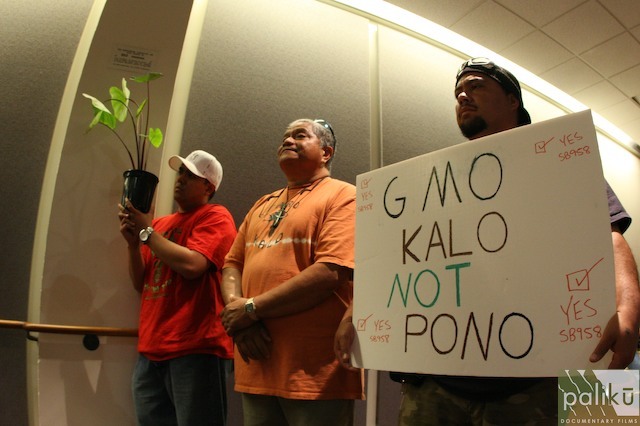
<p>YET, in a 9-to-3 vote, <strong>the committee amended the bill to prohibit any future moratoriums on any GMO products, even at the county level</strong>. At the same time, they reduced the moratorium to 5 years and limited the protected taro plants to the Hawaiian varieties only. Under this amended bill, Haloa will not be protected. Now, other varieties of taro, like bun long, can still be genetically altered and cross-pollinate with the Hawaiian varieties, spreading the genetic alterations.  More startling, this bill now also <a href="http://northshorekauai.com/2008/03/29/council-votes-no-gmo-taro/">robs local communities of their ability to address GMO concerns in their own neighborhoods</a>.</p>
<p><img src="/kahea/kahea/images/MalamaHaloa50.jpg" alt="" height="287" width="432" /></p>
<p>But we are not giving up.<br /><em><br />
&#8220;They should kill this bill and face the consequences and the wrath of the people. &#8220;It&#8217;s ridiculous. They don&#8217;t want to listen. But this is not the end. This is just the beginning.&#8221;</em> &#8211; Jerry Konanui, Big Island Taro Farmer</p>
<p>The kuleana to protect elder brother, Haloa, is too important to turn our backs on! We stand with the taro farmers and the thousands of people who voiced uncompromised support for protecting Haloa. There are still four weeks left in the Legislative Session. And anything can happen.  <a href="http://www.kahea.org/gmo/">Learn more at the website</a> and on the <a href="http://kahea.wordpress.com/category/gmo">KAHEA blog</a>.</p>
<p>In the meantime, every member of the Agriculture Committee is up for re-election this year. Prepare to plant your vote&#8211; <a href="http://hawaii.gov/elections/voters/registration.htm">Register to vote</a>!<br /><a href="http://kahea.wordpress.com/2008/03/07/planting-and-empowering/"><br />
The momentum of this movement is stronger than ever</a>. People all over the islands are now stepping up at the local level, starting campaigns of homegrown resolutions, speaking about this issue to every neighborhood board, at schools, registering voters, and continuing to take action, and to share.</p>
<p><a href="/kahea/kahea/images/kalo-plant_ka-leo.jpg/image_view_fullscreen"><img src="/kahea/kahea/images/kalo-plant_ka-leo.jpg" alt="" height="300" class="alignnone size-medium wp-image-93" width="224" /></a></p>
<p>This year could be revolutionary. Deepest mahalos to all who have shown their support and love, and who have taken action. This latest action is simply fuel for our imu! And we hungry!</p>
<p>Learn more:</p>
<p><a href="http://www.hawaiiseed.org/">http://www.hawaiiseed.org/</a></p>
<p><a href="http://www.kahea.org/gmo">http://www.kahea.org/gmo</a></p>
<p><a href="http://www.centerforfoodsafety.org/geneticall7.cfm">http://www.centerforfoodsafety.org/geneticall7.cfm</a></p>
									]]></content:encoded>
    <dc:publisher>No publisher</dc:publisher>
    <dc:creator>kahea</dc:creator>
    <dc:rights></dc:rights>
    
      <dc:subject>activism</dc:subject>
    
    
      <dc:subject>gmo</dc:subject>
    
    
      <dc:subject>island sustainability</dc:subject>
    
    
      <dc:subject>kalo</dc:subject>
    
    
      <dc:subject>land and cultural rights</dc:subject>
    
    
      <dc:subject>sustainability</dc:subject>
    
    <dc:date>2008-04-05T00:26:43Z</dc:date>
    <dc:type>Blog Entry</dc:type>
  </item>


</rdf:RDF>